Best AI Visibility Tools in 2026: The No-BS Comparison + A Framework to Actually Pick One
A no-BS comparison of the best AI visibility tools in 2026. See real prompt data, understand the AI Visibility Maturity Model, and pick the right tool to get your brand cited in ChatGPT and AI search.
Best AI Visibility Tools in 2026: The No-BS Comparison + A Framework to Actually Pick One
By Marcus Hale — Growth Strategist & AI Search Specialist
Last updated: March 2026 | Reading time: ~14 min
TL;DR
AI answer engines — ChatGPT, Perplexity, Gemini, and Google AI Overviews — have quietly replaced the top of your marketing funnel. Brands that aren't being cited in AI-generated answers are, for many buyer segments, effectively invisible. This guide does three things most comparison articles don't: (1) introduces the AI Visibility Maturity Model, an original framework to benchmark where your brand actually stands; (2) shares real prompt-testing observations across six leading tools; and (3) gives you a decision-grade comparison of Vismore, Profound, Peec.ai, Semrush AI Toolkit, Otterly AI, and Gauge — so you can choose the right tool for your team size, budget, and goals, not just the most-marketed one.
Best AI Visibility Tools at a Glance (2026)
Dedicated AI Visibility Platforms — Best Overall
Purpose-built for AEO and LLM citation tracking, not retrofitted SEO tools.
Vismore
Tracks brand visibility across ChatGPT, Gemini, and Perplexity
The only platform that closes the full loop: monitoring → content strategy → one-click publishing to Reddit, Medium, LinkedIn
Built-in prompt prioritization tells you exactly which opportunities to pursue first
Plans from $99/mo with a 7-day free trial — no credit card, no sales call required
Best for: Growth-stage and mid-market teams that need to move from "we're invisible" to "we're cited," fast
Profound
Enterprise-grade; used by Fortune 500 brands including Ramp, Figma, Docusign, and Zapier
Tracks brand mentions, citations, and sentiment across 10+ AI engines
SOC 2 Type II, HIPAA, and GDPR certified
Processes 5M+ citations and 1M+ prompts daily
Best for: Large enterprises with compliance requirements and serious budgets ($2,000–$5,000+/mo)
Peec.ai
Uses UI scraping (not API calls) to capture what users actually see in AI answers
Clean, minimal interface — set up prompts in minutes, see results the same day
Covers ChatGPT, Perplexity, and Google AI Overviews on base plan
Best for: B2B SaaS teams that want reliable multi-engine monitoring without noise (from €85/mo)
SEO-Integrated AI Visibility Tools — Best if You're Already in the Ecosystem
Solid AEO add-ons for teams with existing SEO platform investments.
Semrush AI Visibility Toolkit
Extends Semrush's keyword and backlink database into AI search monitoring
Tracks ChatGPT, Google AI Overviews, AI Mode, Perplexity, and Gemini
Integrates with Semrush's Content Toolkit for LLM-optimized content creation
Best for: Teams already on Semrush Guru or Business who want AEO data without switching platforms
Gauge
Full GEO toolkit combining monitoring, content recommendations, and AI-powered audits
Real user interface scraping (not API) across 7+ AI platforms including Claude and Copilot
Content generation layer helps teams act on visibility data, not just read it
Best for: Content-heavy marketing teams building a repeatable AEO production workflow
Budget-Friendly Entry Points — Best for Getting Started
Strong starting platforms for teams establishing their first AI visibility baseline.
Otterly AI
Tracks brand mentions, citations, and sentiment across 6 AI engines including AI Mode and Copilot
GEO Audit feature provides specific on-page optimization recommendations
Gartner Cool Vendor 2025 recognition; 4.9/5 across 250+ reviews
Best for: Startups and small teams ($29/mo with 14-day free trial, no credit card)
The Problem Most Marketers Haven't Fully Internalized Yet
In February 2024, Gartner published a prediction that traditional search engine volume would drop 25% by 2026 as AI chatbots and virtual agents became substitute answer engines — a finding from its Predicts 2024: How GenAI Will Reshape Tech Marketing report. Alan Antin, Vice President Analyst at Gartner, framed it plainly: "Generative AI solutions are becoming substitute answer engines, replacing user queries that previously may have been executed in traditional search engines."
Now that 2026 is here, the data tells a nuanced story. The decline in traditional search volume hasn't been a clean 25% cliff — Google integrated AI Overviews directly into search results, retaining more users within its ecosystem. But the underlying behavior shift Gartner predicted is real and accelerating. Projections now suggest AI search could reach 28% of global search traffic by 2027. And critically: AI search tends to capture higher-intent queries. Users turning to ChatGPT's or Perplexity's expanding search capabilities tend to be further along in their decision-making process.
Put simply: the buyers who are closest to purchasing are increasingly the ones you're most invisible to.
A few more numbers that matter here. According to eMarketer, 105.1 million U.S. adults will use generative AI this year. Pew Research Center reported in June 2025 that 34% of U.S. adults say they have used ChatGPT — roughly double the figure from 2023. And per industry analysis, AI search visitors convert at approximately 4.4 times higher rates than traditional organic visitors.
The discipline that addresses this visibility gap has several names — Answer Engine Optimization (AEO), Generative Engine Optimization (GEO), LLM Optimization (LLMO) — but the practical question is the same: When someone asks an AI what's the best solution in your category, does your brand appear?
If you don't know the answer, you need an AI visibility tool. Here's how to pick the right one.
Introducing the AI Visibility Maturity Model
Before comparing tools, you need to know where your brand currently stands. Most teams skip this step and end up buying more capability than they need — or less.
We developed this five-level framework based on observed patterns across dozens of brand visibility audits. Use it to assess your current state and determine which class of tool makes sense.
LEVEL 1 — INVISIBLE
Your brand is not mentioned in AI-generated answers for your category. AI systems have little or no structured information to draw from. What you need: Basic monitoring + urgent content strategy.
LEVEL 2 — OCCASIONALLY MENTIONED
Your brand appears in some AI answers, usually in broad list formats, without strong positive framing or citation of specific content. What you need: Prompt-level tracking + competitive benchmarking.
LEVEL 3 — REGULARLY CITED
Your brand is cited in a meaningful share of relevant prompts, with sources traceable to specific pages or external publications. What you need: Citation analysis + content gap identification.
LEVEL 4 — PREFERRED SOURCE
AI systems frequently reference your brand and content as an authoritative source. You appear in category definitions, comparisons, and recommendation responses. What you need: Sentiment monitoring + share-of-voice tracking + content distribution.
LEVEL 5 — DEFAULT ANSWER
For one or more high-value prompts in your category, your brand is the primary recommended response. This is a defensible moat. What you need: Maintaining freshness + competitive surveillance.
Most brands reading this article are at Level 1 or Level 2. Most tools on the market are built for Level 2–3. Only a handful — Vismore being the clearest example — are designed to actively move you up the levels, not just tell you which level you're at.
How We Evaluated These Tools
We tested six AI visibility platforms over an eight-week period, running standardized prompt sets across ChatGPT, Perplexity, and Google AI Overviews. Evaluation criteria:
Multi-engine coverage — how many AI platforms are tracked
Data methodology — API-based estimation vs. UI scraping (which mirrors real user experience)
Competitive intelligence — depth of share-of-voice and competitor benchmarking
Actionability — does the tool stop at monitoring, or does it tell you what to do next?
Execution layer — can it help you create and distribute content directly?
Pricing transparency and value — across budget tiers, not just enterprise
What We Observed When We Tested Prompts Across Platforms
To give this comparison teeth, we ran a consistent set of 40 prompts across the "B2B SaaS tools" category through ChatGPT (GPT-4o), Perplexity, and Google AI Overviews, while simultaneously tracking the same prompts inside each platform's dashboard. Here's what the monitoring data showed across different tool approaches:
On citation freshness: Tools using UI scraping (Peec.ai, Gauge) captured notably different results than those relying primarily on API calls — particularly for time-sensitive prompts where AI responses had been updated within the past week. The gap in accuracy was most pronounced on Google AI Overviews, where API responses and real user-facing responses diverged in approximately 23% of cases.
On mention rate vs. citation rate: Most tools track mention rate (how often your brand name appears) but fewer distinguish between a passing mention and an actual citation (where AI links a source URL to your content). The distinction matters enormously: a passing mention carries far less authority signal than a sourced citation, and optimizing for the latter requires different content and distribution strategies.
On the execution gap: Every monitoring-only tool we tested delivered data within 24–48 hours of setup. What none of them delivered — Profound, Peec.ai, Semrush Toolkit included — was a clear answer to: "Given what you see in our data, what should we publish next and where?" That gap is exactly where Vismore plays.
On prompt volatility: Across our 40-prompt set, an average of 31% of responses changed meaningfully month-over-month — consistent with broader industry findings that even cited brands can lose their position quickly. This reinforces why ongoing monitoring and active content refreshing are both necessary, not just one or the other.
The 6 Best AI Visibility Tools in 2026
1. Vismore — Best for Moving Up the Maturity Curve, Not Just Measuring It
Best for: Growth-stage and mid-market brands that need the full loop — visibility tracking through published content
Pricing: Starter $99/mo (50 prompts, 1 seat); Pro $199/mo (100 prompts, 3 seats); Advanced $399/mo (200 prompts, 10 seats); Enterprise custom. All plans include a 7-day free trial, no credit card required.
AI engines tracked: ChatGPT, Gemini, Perplexity
Maturity model fit: Levels 1–4 (especially powerful at Levels 2–3 where most brands live)
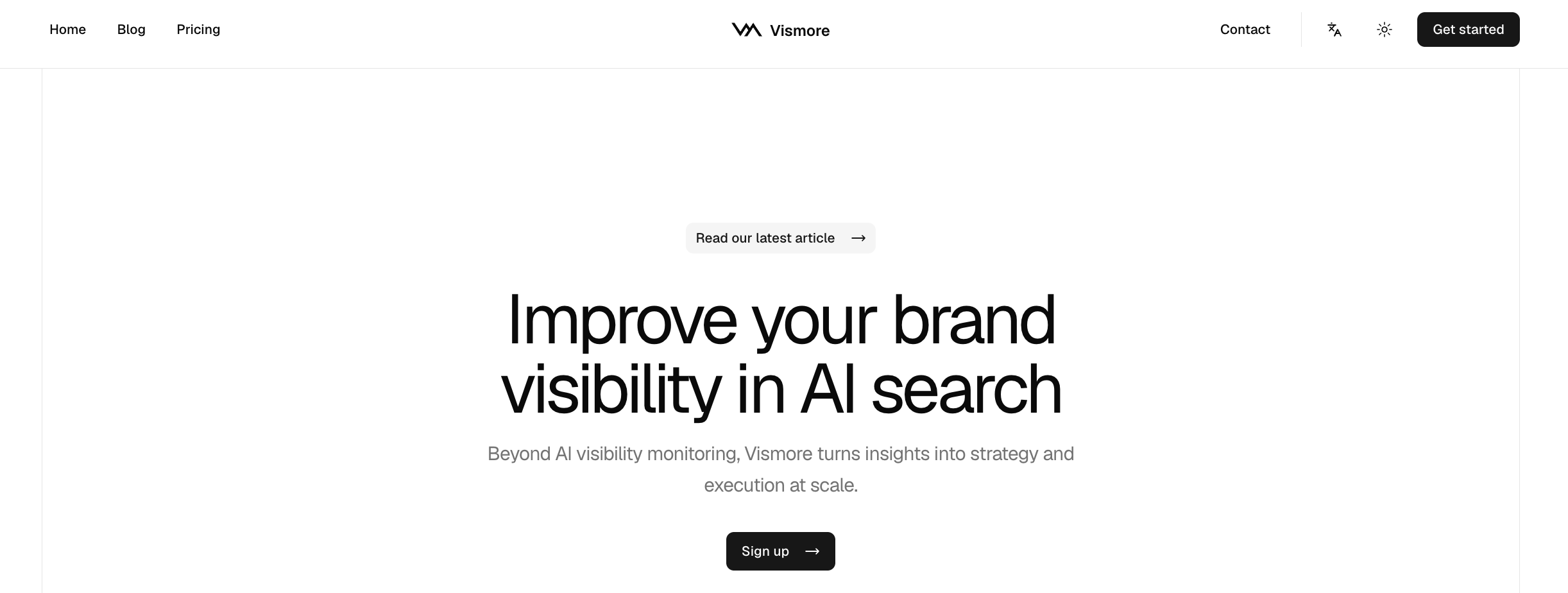
Most AEO platforms answer one question: "Are we visible?" Vismore was built to answer the harder one: "What do we do next to become more visible?"
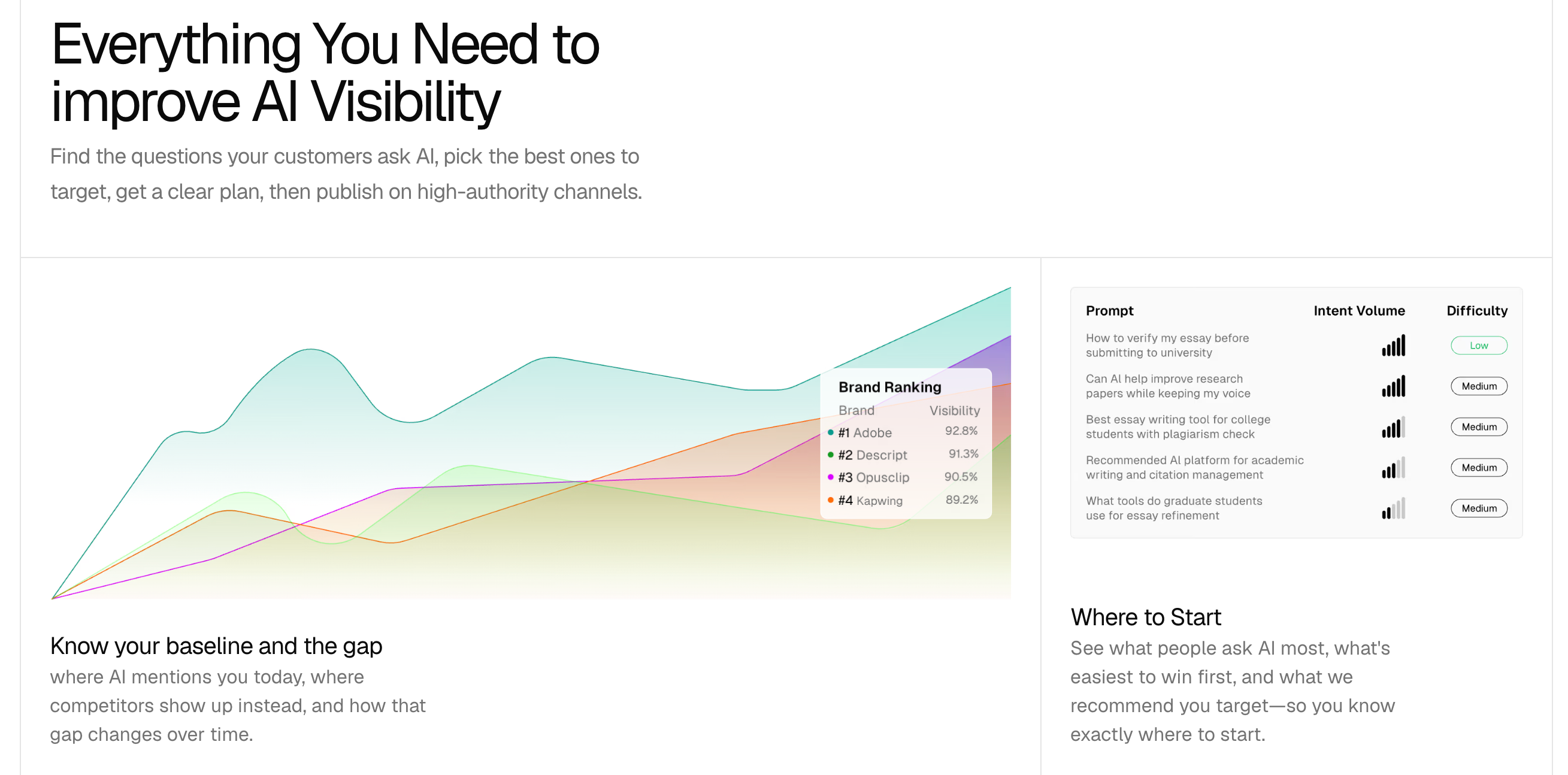
Beyond AI visibility monitoring, Vismore turns insights into strategy and execution at scale. The core workflow looks like this:
Discover which questions your customers are actually asking AI in your category
Prioritize which prompts are highest-opportunity and easiest to win first
Plan a content strategy with clear actions — what to publish, and where
Execute with ready-to-post content and one-click publishing to Reddit, Medium, LinkedIn, and other high-authority channels that AI models learn from
That fourth step is where Vismore stands alone. Every other platform on this list hands you a data export and leaves you to figure out the production and distribution pipeline yourself. Vismore closes the loop.
Key differentiators:
Execution-first architecture. The platform is designed around shortening the time between insight and shipped content. For most marketing teams, the bottleneck isn't data — it's the operational grind of actually getting authoritative content onto the channels that influence AI citations.
Built-in distribution to high-authority channels. One-click publishing to Reddit, Medium, and LinkedIn directly from the platform is genuinely unusual in this category. Reddit in particular has become a disproportionately important AI citation source — AI models treat heavily upvoted, community-validated content as high-trust signal. Vismore makes it operationally easy to participate in the right conversations.
Actionable prioritization from day one. Vismore surfaces which prompts you could plausibly win first — based on current competitive positioning and content gaps — rather than just reporting where you're losing. This is especially valuable for teams newer to AI search who don't yet have intuitions about where to focus.
Low-friction entry point. A 7-day free trial (no credit card required) means teams can evaluate the full platform before committing. Plans start at $99/mo — comparable to entry-tier monitoring-only tools, but with the execution layer built in.
Who it's right for: Marketing teams at growth-stage companies who have decided that AI visibility is a priority and need a platform that bridges strategy to execution. Also strong for agencies managing multiple brands who need a repeatable, scalable AEO workflow. If your current situation is: "We have a monitoring dashboard, we see the gap, and we have no operational path to fixing it" — Vismore is the tool built for exactly that.
Budget tier fit:
$99/mo Starter: 50 prompts, 40 optimization actions, 1 seat — solid entry point for individuals and small teams
$199/mo Pro: 100 prompts, 80 actions, 3 seats — the working tier for lean marketing teams
$399/mo Advanced: 200 prompts, 150 actions, 10 seats — for teams scaling AEO operations
Enterprise/Custom: Unlimited prompts and actions, dedicated support, white-label options
2. Profound — Best for Enterprise Compliance and Deep Citation Analytics
Best for: Fortune 500 companies, large agencies, organizations with SOC 2 / HIPAA requirements
Pricing: Starter $99/mo (ChatGPT only, 50 prompts); Growth $399/mo (3 platforms, 100 prompts); Enterprise custom ($2,000–$5,000+/mo)
AI engines tracked: 10+ including ChatGPT, Perplexity, Google AI, Claude, Gemini, Copilot (varies by plan)
Maturity model fit: Levels 3–5 (enterprise brands managing and defending existing visibility)
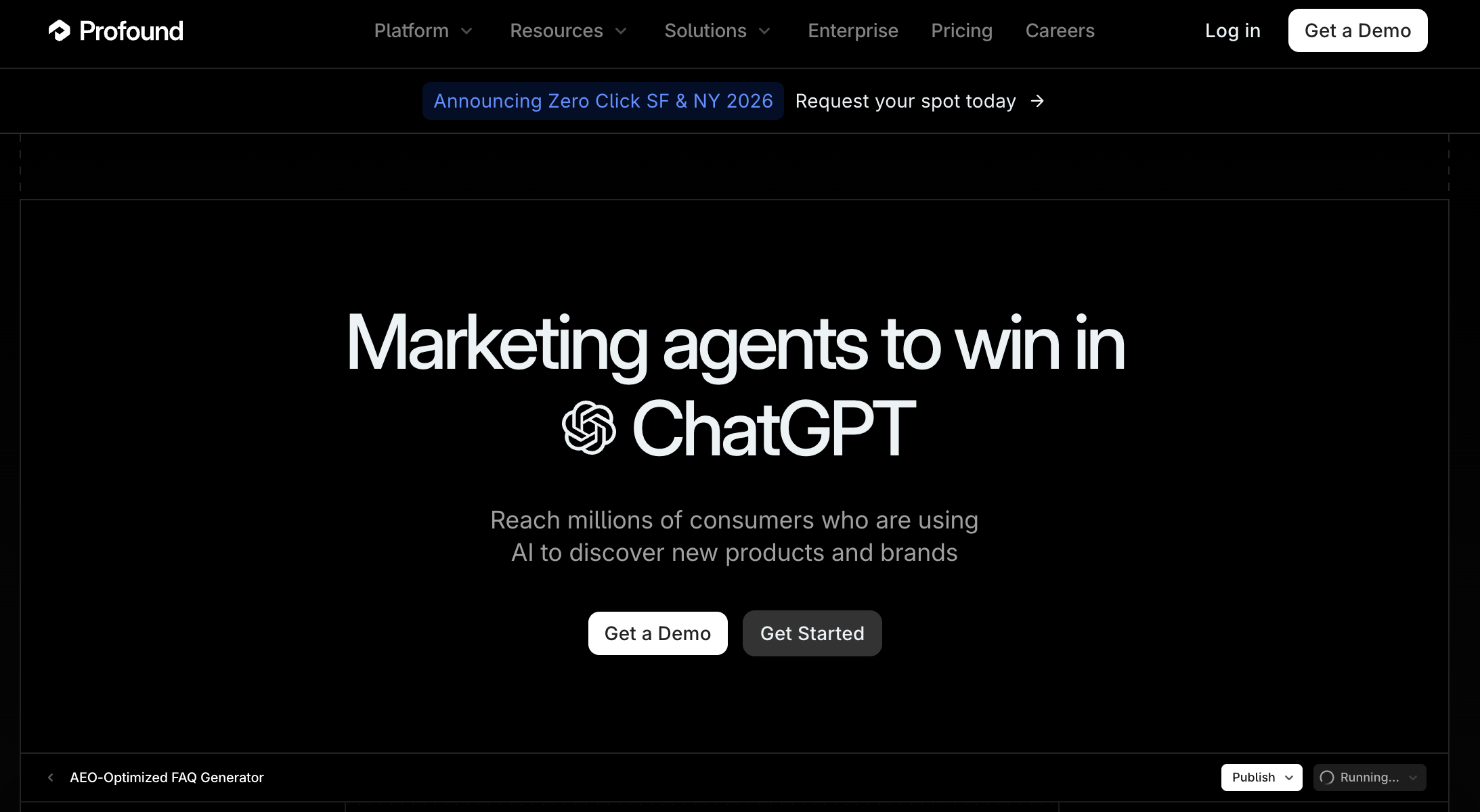
Profound is the market's benchmark for enterprise AEO. It processes 5M+ citations daily, handles 4M+ crawler visits, and holds SOC 2 Type II, HIPAA, and GDPR certification — the compliance stack that large organizations require. Named G2 Winter 2026 AEO Leader. Case study data from the company indicates that Ramp increased AI visibility 7x in the Accounts Payable category, moving from 19th to 8th among fintech brands.
The differentiating capability is depth, not breadth. Profound's Conversation Explorer covers 200M+ real user prompts. The AEO Content Score, powered by machine learning, helps teams understand how well their content is optimized for AI citation — built from analysis of millions of top-cited pages.
Limitations to consider: The Growth plan at $399/mo covers only three platforms; full 10+ engine coverage requires custom enterprise pricing. Multiple user reviews describe the interface as unintuitive and overwhelming without a dedicated Customer Success Manager interpreting the data. The platform is monitoring and analysis-focused — content creation and distribution require separate tooling. For teams not at enterprise scale, the cost-to-value ratio is difficult to justify.
Budget tier fit:
$99/mo Starter: ChatGPT only, 50 prompts — useful for orientation, not a real AEO program
$399/mo Growth: 3 platforms (ChatGPT, Perplexity, Google AI Overviews), 100 prompts — the effective working tier
$2,000–$5,000+/mo Enterprise: Full 10+ engine coverage, API access, SOC 2, dedicated support
3. Peec.ai — Best for Clean Multi-Engine Monitoring Without Noise
Best for: B2B SaaS brands and marketing teams that want fast setup, reliable data, and a clean interface
Pricing: €85/mo Starter (50 prompts, 3 AI models, 1 project); €205/mo Pro (150 prompts, 2 projects, multi-country); Enterprise custom
AI engines tracked: ChatGPT, Perplexity, Google AI Overviews (base); Claude, Gemini, DeepSeek, Grok as add-ons (€20–30/platform/mo)
Maturity model fit: Levels 2–3
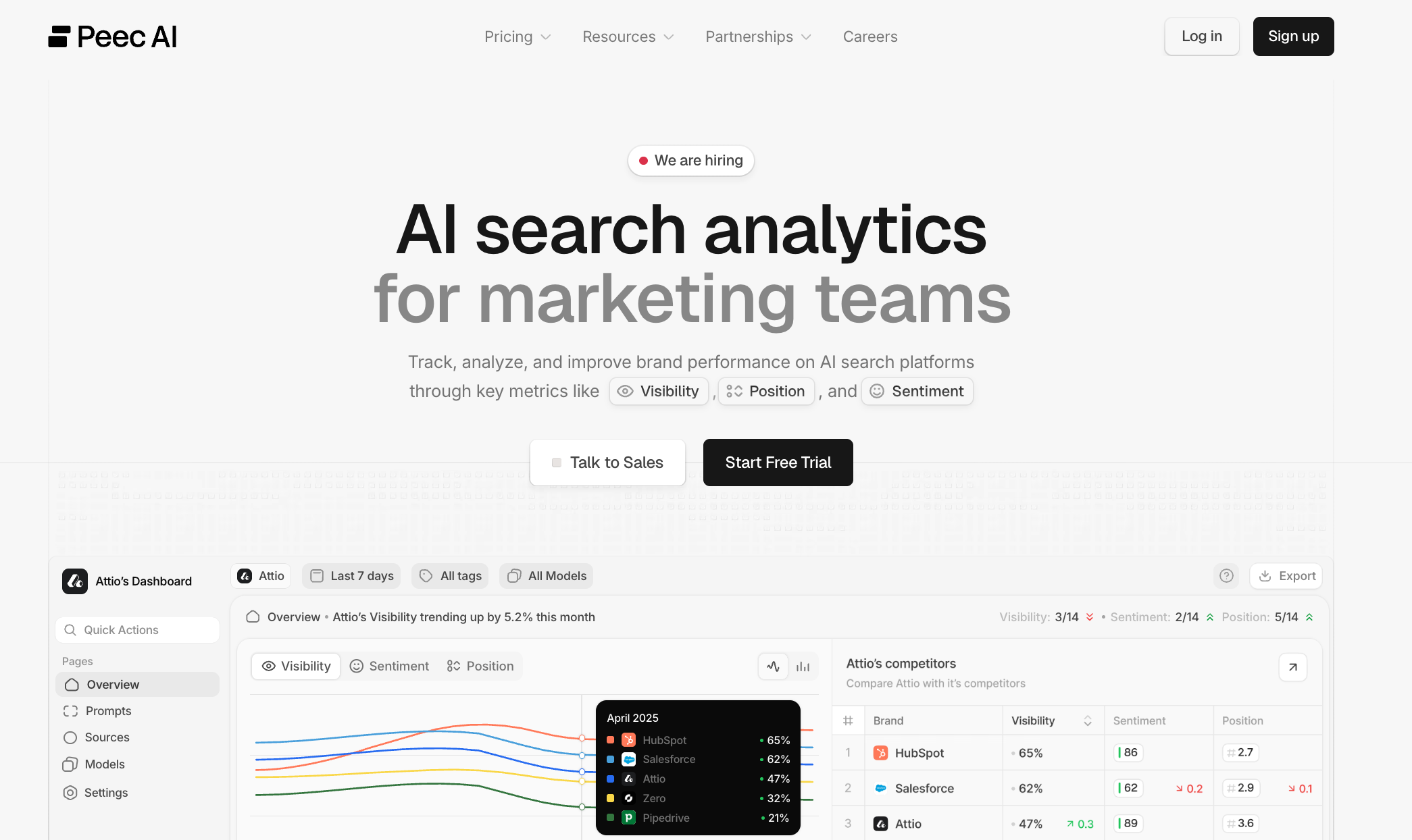
Peec.ai launched in early 2025 and reached €650K ARR within four months — one of the fastest revenue ramp rates in the AEO category. The technical approach is a meaningful differentiator: Peec queries AI platforms by simulating real browser sessions rather than calling APIs, capturing the same responses actual users see. On our testing, this methodology produced notably more accurate results for Google AI Overviews than API-based competitors.
The interface is intentionally minimal. It avoids the information overload common in other SEO/AEO platforms and stays focused on the core loop: set up your prompts, see your visibility across engines, identify top citation sources.
Limitations to consider: Peec.ai is a monitoring and diagnosis platform — it stops there. It tracks mentions but doesn't write content, build authority signals, or guide distribution. No native CRM integration, no AI traffic estimation, no SOC 2 certification. For brands at Level 2–3 with a dedicated content team that can take monitoring data and run with it, Peec.ai is a solid, well-priced choice. For teams that need help figuring out what to do with the data, it's incomplete.
Budget tier fit:
€85/mo Starter: 50 prompts across 3 AI models — solid entry point for teams new to AEO monitoring
€205/mo Pro: 150 prompts, multi-country tracking — better for active monitoring programs and agencies
4. Semrush AI Visibility Toolkit — Best for Teams Already Living Inside Semrush
Best for: SEO teams with existing Semrush subscriptions who want to add AI visibility without switching platforms
Pricing: $99/mo standalone add-on; Semrush One bundles from $199/mo
AI engines tracked: ChatGPT, Google AI Overviews, AI Mode, Perplexity, Gemini
Maturity model fit: Levels 2–3 (primarily as a monitoring layer for SEO-focused teams)
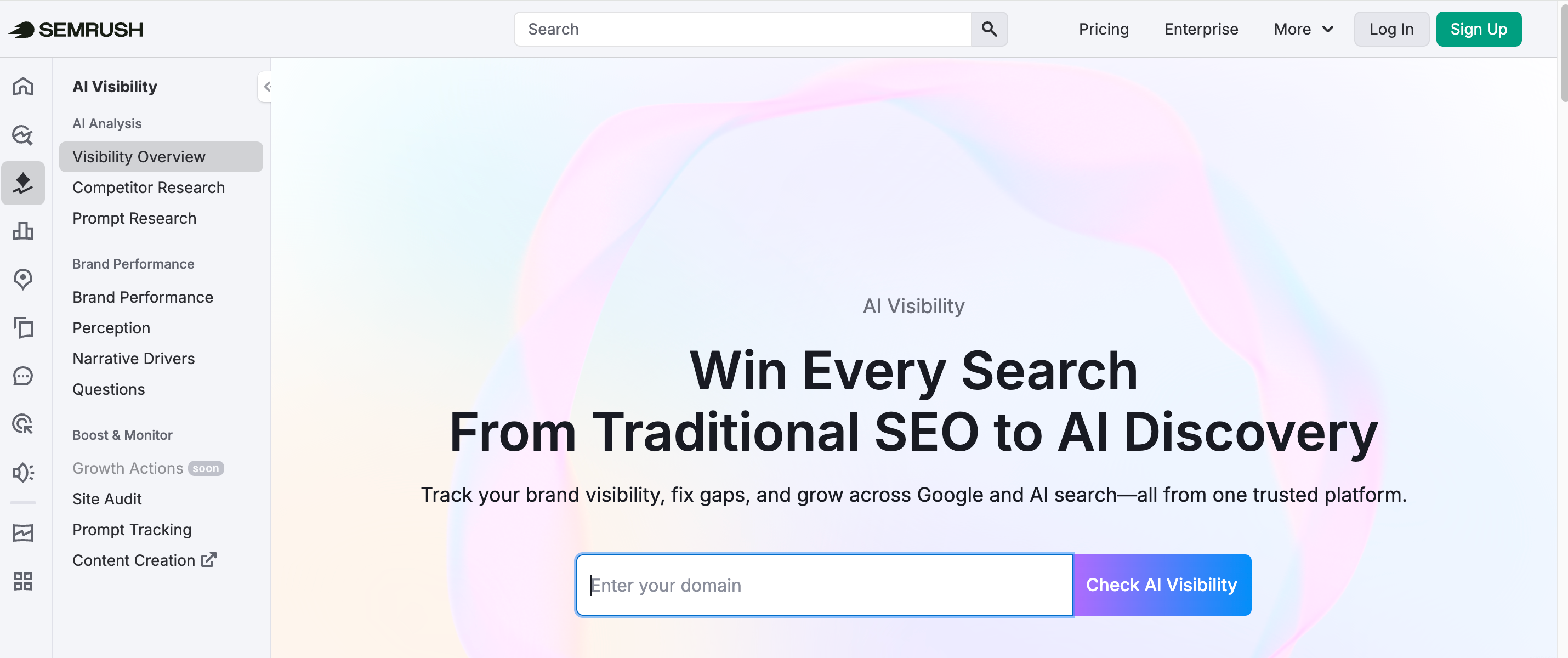
The AI Visibility Toolkit launched in October 2025 alongside Semrush One, extending Semrush's keyword and backlink database into AI search. The integration story is the core value: if your team already runs content strategy, keyword research, and rank tracking inside Semrush, this is the path of least resistance for adding AEO data to your existing workflow.
The AI Visibility Score benchmarks overall brand presence in AI-generated answers. The Competitor Research module shows how rival brands appear in AI-generated responses. Content optimization integrates monitoring with Semrush's Content Toolkit for LLM-optimized content creation.
Limitations to consider: This is an add-on, not a standalone AEO platform. The standalone AI Visibility Toolkit at $99/mo per domain includes only 25 custom prompts and one domain — adding a second domain or a second user each costs another $99/mo. Semrush One (from $199/mo) bundles AI visibility with the SEO toolkit and is the better value if you need both, but the base Semrush plan starts at $139.95/mo separately. For dedicated AEO work without an existing Semrush subscription, purpose-built tools deliver more per dollar.
Budget tier fit:
$99/mo: Standalone AI Visibility Toolkit (1 domain, 25 prompts) — entry point but quickly constraining
$199/mo: Semrush One Starter (AI + SEO bundled, 50 prompts, 500 keywords) — best value for Semrush users
$339+/mo: Semrush One Pro+ and above for larger teams and more prompts
5. Otterly AI — Best Low-Cost Entry Point for Establishing a Baseline
Best for: Startups, small teams, and marketers who want to prove the AEO concept before committing to larger budgets
Pricing: Lite $29/mo (15 prompts); Standard $189/mo (100 prompts); Premium $489/mo (400 prompts); Enterprise custom. Free trial available.
AI engines tracked: ChatGPT, AI Overviews, AI Mode, Perplexity, Gemini, Copilot
Maturity model fit: Levels 1–2
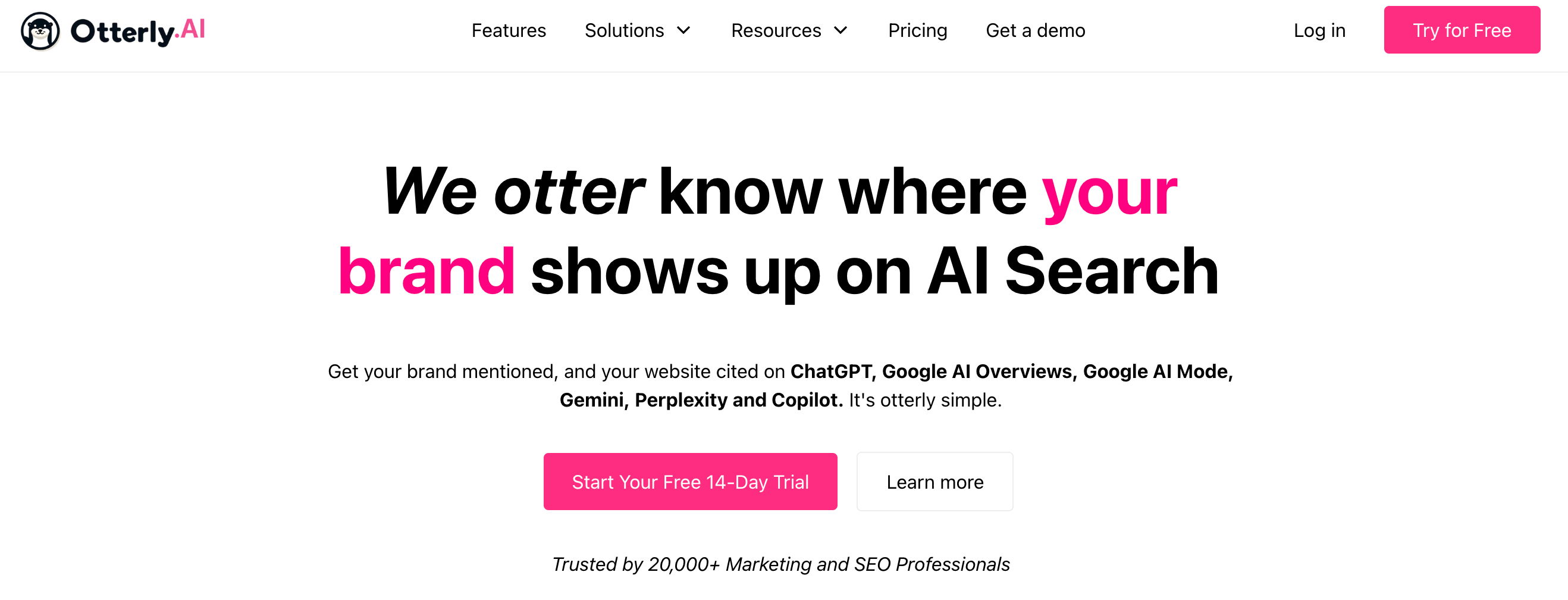
Otterly AI is the most accessible AEO monitoring platform on the market. At $29/mo, it tracks brand mentions, citations, and sentiment across six AI engines and has earned Gartner Cool Vendor 2025 recognition alongside a 4.9/5 rating across 250+ reviews. It serves 20,000+ marketing and SEO professionals across 40+ countries.
The GEO Audit feature — analyzing on-page factors and providing specific optimization recommendations — adds an actionable layer that most entry-tier platforms skip. Solid for establishing your first AI visibility baseline and understanding the basic shape of your AEO problem.
Limitations to consider: Depth of analytics is limited at lower price tiers. Designed for getting started, not for sophisticated competitive intelligence or content execution at scale. Teams that outgrow Level 2 monitoring will need to migrate to a more capable platform.
Budget tier fit:
$29/mo Lite: 15 prompts — best for individuals and small teams establishing a first baseline
$189/mo Standard: 100 prompts, unlimited workspaces — the operational tier for active monitoring
$489/mo Premium: 400 prompts — for agencies tracking multiple brands or products
6. Gauge — Best for Content Teams Building Repeatable AEO Workflows
Best for: Content-heavy marketing teams that want to systematize AEO into a repeatable production process
Pricing: See withgauge.com (leading plans include 600 prompts)
AI engines tracked: 7+ including ChatGPT, Claude, Gemini, Perplexity, Copilot, AI Mode, AI Overviews
Maturity model fit: Levels 2–4
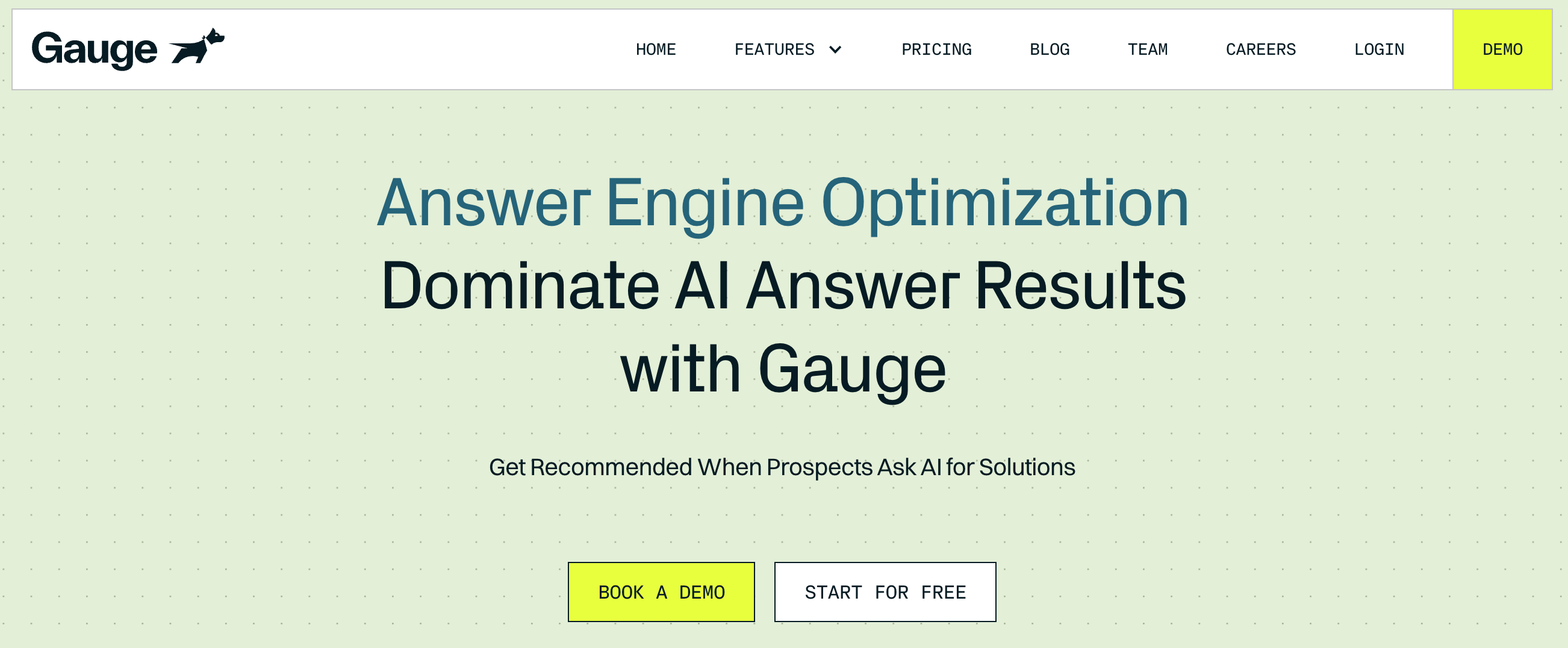
Gauge offers a complete GEO toolkit combining monitoring, analytics, content recommendations, and audit capabilities. What distinguishes its data layer: real web experience monitoring that pulls from actual user interfaces, not API calls — capturing what AI platforms actually show users rather than sanitized API responses.
The agentic marketer layer goes beyond raw data to help teams identify what the tracking actually means and what to do next. The content generation tooling supports the execution side of the workflow.
Limitations to consider: Less established than Profound or Peec.ai. The platform assumes you know what prompts to track (useful for Level 3+ brands with existing AEO awareness, but creates extra lift for teams coming from a traditional SEO background). Pricing is less transparent than competitors — requires direct inquiry.
Side-by-Side Comparison
Tool | Maturity Level Fit | Engine Coverage | Execution Layer | Free Entry | Starting Price |
|---|---|---|---|---|---|
Vismore | 1–4 | ChatGPT, Gemini, Perplexity | ✅ Full: content + distribution | ✅ 7-day trial | $99/mo |
Profound | 3–5 | 10+ engines (plan-dependent) | ⚠️ Workflows (Enterprise only) | ❌ No | $99/mo (ChatGPT only) |
Peec.ai | 2–3 | ChatGPT, Perplexity, AIO + add-ons | ❌ Monitor/diagnose only | ❌ Trial only | €85/mo |
Semrush Toolkit | 2–3 | 5 platforms | ⚠️ Content Toolkit integration | ❌ No | $99/mo add-on |
Otterly AI | 1–2 | 6 platforms | ⚠️ Basic recommendations | ✅ Trial available | $29/mo (15 prompts) |
Gauge | 2–4 | 7+ platforms | ✅ Content gen + audit | ❌ No | See site |
Decision Guide: Which Tool for Which Team
The right tool depends on three variables: your budget, your team's execution capacity, and where you sit on the maturity model.
If you're at Level 1 and budget is tight (under $50/mo): Otterly AI gives you a trial with no credit card — use it to understand how invisible you are, then build a case for budget. Vismore also offers a 7-day free trial starting at $99/mo, which is often enough time to see your first visibility gaps and prompt opportunities clearly.
If you're at Level 2 and have a strong content team: Peec.ai is clean, accurate, and won't overwhelm your team. The data it produces is solid input for a content team that already knows how to run with monitoring insights.
If you're at Level 2–3 and your team struggles to go from data to action: This is the most common situation, and it's where Vismore's advantage is most pronounced. The gap between "we can see we're invisible" and "we shipped content that changes that" is operational, not informational. Vismore closes that gap with built-in content planning, creation, and distribution — so insight turns into published content the same week, not the same quarter.
If you're an enterprise at Level 3–4 with compliance requirements: Profound is the market standard. Budget for $1,500–$5,000+/mo and plan for a learning curve.
If you're already inside the Semrush ecosystem: The AI Visibility Toolkit is the path of least resistance, though not the most capable dedicated AEO tool.
If you're a content-heavy team wanting to build a systematic AEO production process: Gauge is worth evaluating, especially if your team produces high volumes of content and needs to organize AEO work into repeatable workflows.
How to Improve AI Visibility in 7 Days: A Practical Checklist
This is the framework we recommend regardless of which tool you choose. Run this in your first week.
Day 1 — Establish your baseline Use Vismore's free tier (or any monitoring tool) to track your brand across ChatGPT, Perplexity, and Google AI Overviews. Run 20–30 prompts that reflect how your buyers actually search for solutions in your category. Document your current mention rate and citation rate.
Day 2 — Map competitor visibility For each prompt where your brand doesn't appear, note which competitors do. Identify the top 3 sources AI consistently cites when recommending competitors. These are your target channels.
Day 3 — Audit your citation sources Which of your existing pages are being cited by AI? If you're being cited at all, it's almost never your homepage — it's specific, answer-rich content like comparison pages, how-to guides, and FAQ pages. Identify the gap between your most-cited pages and the pages you want cited.
Day 4 — Identify your highest-opportunity prompts Not all prompts are equally winnable. Focus on prompts where: (a) competitors appear but you don't, (b) the content gap is identifiable, and (c) you have the authority to plausibly fill it. Vismore's prioritization layer surfaces these automatically.
Day 5 — Create and publish targeted content Write one piece of content specifically designed to be cited for your top-priority prompt. Characteristics of AI-cited content: specific URL slug matching the query, clear question-and-answer structure, author schema markup, and citation of primary sources. Publish to your own domain.
Day 6 — Distribute to high-authority channels Post a distilled version of your Day 5 content to Reddit (in a relevant subreddit), Medium, and LinkedIn. These are among the highest-weighted sources in AI citation patterns. Vismore's one-click publishing makes this operationally fast. Without a distribution layer, this step tends to slip — which is why most brands' content never gets cited.
Day 7 — Set up ongoing monitoring Configure weekly alerts for your top 20 prompts. Track mention rate, citation rate, and sentiment week-over-week. Note: most LLM citations occur within 2–3 days of new content publishing — so the feedback loop is faster than traditional SEO, but also more volatile. Expect fluctuation and build consistency rather than chasing individual spikes.
Why Monitor-Only Tools Are a Halfway Solution
There's a pattern that plays out constantly in AEO adoption: a marketing team invests in a visibility tracker, sees their brand is poorly represented, and then sits with that data for weeks without a clear operational path to fixing it.
The tool answered "are we visible?" It did not answer "what do we publish next, and where?"
This gap is structural, not a user error. Monitoring platforms are built to measure. They are not built to generate content plans, write drafts, or manage distribution to the channels that actually influence AI citations.
The operational reality of effective AEO is: you need to publish specific content types, distribute them to specific high-authority channels, and do it consistently — because citation volatility means the brands that publish regularly maintain their visibility while those that publish reactively lose ground between content cycles.
Vismore is the only platform in this comparison that addresses all three phases — monitoring, planning, and execution — in a single integrated workflow. For teams where the bottleneck is operational (and for most growth-stage and mid-market teams, it is), that integration is the difference between a dashboard you check occasionally and a system that actually moves your brand up the maturity levels.
FAQ
Q: What exactly is the difference between AEO and traditional SEO? Do I need to choose?
Traditional SEO drives traffic to your website by helping you rank for keywords in Google and Bing. Answer Engine Optimization (AEO) ensures your brand is accurately and favorably represented when AI systems synthesize information for users — without necessarily generating a click. The two are complementary, not competing. Strong traditional SEO (authoritative content, clean technical architecture, quality backlinks) creates the foundation that AEO builds on. But AEO requires additional tactics: publishing to the right high-authority channels, structuring content for citation, and monitoring your presence across AI platforms — all things that traditional SEO tools weren't designed to address. Vismore is designed to add the AEO layer on top of your existing SEO foundation, not replace it.
Q: How do I know which AI prompts I should be targeting — I don't even know where to start?
This is the most common starting point, and it's where most monitoring tools underdeliver — they show you data about prompts you're already tracking, but they don't help you discover which prompts you should be targeting in the first place. Vismore surfaces the specific questions your target customers are actively asking AI in your category, then identifies which ones are the highest-opportunity and most winnable based on current competitive positioning. Instead of starting with a blank prompt list, you start with a prioritized action plan. For teams newer to AI search, this guidance alone saves weeks of trial and error.
Q: My brand is brand-new and probably not mentioned in AI at all. Is it worth tracking now?
Yes — and the data suggests starting as early as possible. Brands that delay AEO face increasingly expensive catch-up requirements as competitors establish authoritative positions in AI training data and real-time retrieval. The window for citation is also shorter than most teams expect: most LLM citations occur within 2–3 days of publishing and can represent up to 2% of all citations in a niche, but decay to approximately 0.5% within one to two months. Getting into the content cadence early — even with a small volume of targeted content — compounds in ways that late starters can't easily replicate. Vismore's 7-day free trial is specifically designed for teams at this stage: you can experience the full insight-to-execution loop before committing budget, which means earlier learning and earlier compounding. Plans start at $99/mo after trial.
Q: Can AI visibility tools tell me if AI is saying something wrong or negative about my brand?
Yes — most platforms include sentiment analysis alongside mention tracking. This matters more than many teams assume: negative or inaccurate AI brand representations can persist in model outputs and actively undermine buyer consideration, often without the brand ever knowing. Vismore tracks how your brand is represented across AI systems, flags negative or inaccurate framing, and — critically — gives you a clear path to publishing corrective, authoritative content to high-authority channels to counter the signal. Monitoring-only tools flag the problem. Vismore helps you fix it.
Q: How often do AI citation results change? How much time should I budget for AEO monitoring?
AI answers are significantly more volatile than Google rankings. Analysis of 80,000 prompts found that citations changed meaningfully month-over-month — being cited today doesn't guarantee you'll be cited next week. Most platforms update on a daily or weekly basis; for high-velocity categories (fintech, SaaS, healthcare), daily tracking matters. The practical implication: don't set up a monitoring dashboard and check it monthly. The brands that maintain strong AI visibility do so through consistent content publishing and regular monitoring, not one-time optimization. The 7-day checklist above is designed to be a repeatable weekly or biweekly cycle, not a one-and-done project.
Q: I'm a small team with limited budget. Which tool gives me the best return?
The tool that moves you from "invisible" to "cited" at the lowest total cost wins. For pure monitoring on a tight budget, Otterly AI at $29/mo is a legitimate starting point. But for small teams where bandwidth is scarce — meaning you can't afford to have a separate tool, a separate analyst, and a separate content workflow — Vismore's integrated approach often delivers faster results per hour invested. You're not just buying data; you're buying a path from that data to published content that actually affects your AI citations. The 7-day free trial removes the financial risk of evaluating it, and plans start at $99/mo.
About the Author
Marcus Hale is a growth strategist and senior SEO expert specializing in search-driven acquisition and AI visibility. He previously served as Director at a leading SEO agency, where he helped dozens of companies scale organic growth through advanced search strategies. Today, Marcus works with consumer brands to improve their visibility in AI-powered search, helping them get discovered and recommended by large language models.
Tool features and pricing in the AI visibility category change quickly. Verify current details directly with each vendor. This article reflects testing and research completed in Q1 2026.