Best AEO Services in 2026: Top AEO Tools Compared for Every Team Size
Compare the best AEO tools in 2026, including Vismore, Profound, Otterly AI, and more. See features, pricing, and real-world insights to choose the right AEO platform for your team.
Best AEO Services in 2026: Top Tools Compared for Every Team Size
Published: April 17, 2026 | Data sources: Gartner, Ahrefs, SE Ranking, Conductor, Superlines | Methodology: 50-prompt test panel across 6 industries, 8 weeks of tracked publishing
The Best AEO Services at a Glance
If you need a quick answer before diving into the full comparison:
🥇 Best overall: Vismore — full-loop AEO from monitoring to one-click publishing
🏢 Best for enterprise / regulated industries: Profound — SOC 2 Type II and HIPAA compliant
💰 Best budget option: Otterly AI — solid baseline monitoring at $29/month
🔗 Best for HubSpot teams: HubSpot AEO — AI visibility data inside your existing CRM
📊 Best for existing Semrush customers: Semrush AI Visibility Toolkit — zero migration friction
🔬 Best for platform-specific depth: SE Ranking / SE Visible — separate trackers per AI engine
No single tool is right for every team. The right choice depends on where your program is currently blocked: monitoring, strategy, or execution. Use this guide to match your scenario to the right tool.
Quick Comparison: 6 Best AEO Services in 2026
Tool | Best For | Monitoring | Strategy | Execution | Entry Price |
|---|---|---|---|---|---|
Vismore | Growth/mid-market teams needing end-to-end workflow | ✅ | ✅ | ✅ One-click publish | $99/mo |
Profound | Enterprise, regulated industries | ✅ Deep | ✅ Partial | ❌ | $99–$399+/mo |
Otterly AI | Budget first step, SMBs | ✅ Basic | ❌ | ❌ | $29/mo |
HubSpot AEO | HubSpot ecosystem teams | ✅ | ❌ | ❌ | $50/mo |
Semrush AI Toolkit | Existing Semrush customers | ✅ | ❌ | ❌ | Add-on / enterprise |
SE Ranking / SE Visible | Mid-market, multi-platform depth | ✅ Deep | ✅ Partial | ❌ | $129+/mo |
"Execution" defined: Native content creation and distribution to channels AI engines actually learn from (Reddit, Medium, LinkedIn, etc.) — without requiring a separate tool. Most platforms stop at monitoring and/or recommendations.
Choose the Right AEO Service for Your Situation
Answer one question: where is your program currently blocked?
Choose Vismore if…
You have visibility data but don't know what to publish or where
Your team's bottleneck is execution speed, not more analysis
You need a closed-loop workflow: monitoring → strategy → publish → measure
You're a growth or mid-market team managing content across many pages or clients
Choose Profound if…
You're in healthcare, fintech, legal, or any environment where data handling must survive a compliance audit
You need SOC 2 Type II and HIPAA certifications to get vendor approval
Your primary need is research-grade monitoring across 10+ AI engines, not execution
Choose Otterly AI if…
You're an SMB or startup that hasn't tracked AI visibility at all yet
Budget is the top constraint and you need a baseline for under $30/month
You want to answer one question first: "Are we appearing in AI answers?"
Choose HubSpot AEO if…
Your CRM, email, and campaign analytics already live in HubSpot
You want AI visibility data without adopting a net-new vendor
You're comfortable with ChatGPT, Gemini, and Perplexity coverage only
Choose Semrush AI Toolkit if…
You're already paying for Semrush and want to avoid a separate AEO vendor
You value seeing AEO and SEO data in the same dashboard
Workflow continuity and team familiarity matter more than dedicated AEO features
Choose SE Ranking / SE Visible if…
You need platform-specific metrics per AI engine (not blended "AI visibility" averages)
You operate across multiple geographic markets
You want the deepest dedicated AEO toolkit available in a mid-market SEO platform
Why AEO Is Now a Primary Marketing Channel
The shift from "interesting trend" to "business-critical" happened faster than most teams expected.
Gartner predicted that by 2026, traditional search engine volume would drop 25%, with AI chatbots and virtual agents becoming "substitute answer engines." Gartner Vice President Analyst Alan Antin stated: "Generative AI solutions are becoming substitute answer engines, replacing user queries that previously may have been executed in traditional search engines. This will force companies to rethink their marketing channels strategy as GenAI becomes more embedded across all aspects of the enterprise."
That prediction is materializing:
AI traffic jumped from 0.02% of global internet traffic in 2024 to 0.15% in 2025 — a rise of more than 7×
ChatGPT dominates with 77.97% of all AI referral visits
AI visitors convert at 14.2% on average vs. Google organic's 2.8%
Platform-specific conversion rates: Claude at 16.8%, ChatGPT at 14.2%, Perplexity at 12.4%
Ahrefs found that organic CTR for queries with AI Overviews dropped from 1.76% to 0.61% — a 65% decline
The GEO/AEO market is valued at $848 million in 2025, projected to reach $33.7 billion by 2034 at a 50.5% CAGR
The critical insight from Ahrefs: only 12% of links cited by ChatGPT, Gemini, and Copilot appear in Google's top 10 for the same query — and 80% of those citations don't rank anywhere in Google for the original query. This means SEO rankings are a poor proxy for AI visibility. You need a separate strategy and separate tools.
Real-World Validation: What Users Actually Say About AEO Tools
While most AEO tools position themselves with strong dashboards and visibility metrics, independent user feedback reveals a more complex reality about how these platforms perform in real-world usage.
Across G2 reviews and practitioner discussions, a consistent pattern emerges: many AEO platforms excel at monitoring brand visibility, but struggle with accuracy, latency, and execution depth.
For example, industry users evaluating enterprise-grade tools like Profound report that dashboard visibility does not always match manual testing results, with some practitioners finding only moderate consistency between platform-reported citations and real AI outputs.
Similarly, broader community feedback highlights a structural gap across most AEO tools: they function primarily as monitoring systems rather than execution engines. While they can show where a brand appears in AI-generated answers, they often do not directly support content creation or distribution workflows needed to improve those results.
G2 review analysis further reinforces this pattern. High ratings in the AEO category tend to reflect usability and onboarding experience, but frequently do not capture deeper issues such as data freshness, model variability, or cross-engine accuracy.
Taken together, these signals suggest an important distinction for buyers: AEO tools should not be evaluated only on reporting quality, but on whether they close the loop between insight and execution.
This creates an important gap between visibility data and real-world impact — a gap most tools do not yet fully solve.
The 6 Best AEO Services: Full Reviews
1. Vismore — Best Overall AEO Service
Best for: Growth-stage and mid-market teams whose primary bottleneck is execution — knowing what to create and where to publish it.
AEO Coverage: Monitoring → Strategy → Execution (full loop)
Pricing: Plans from $99/month with a 7-day free trial, no credit card required.
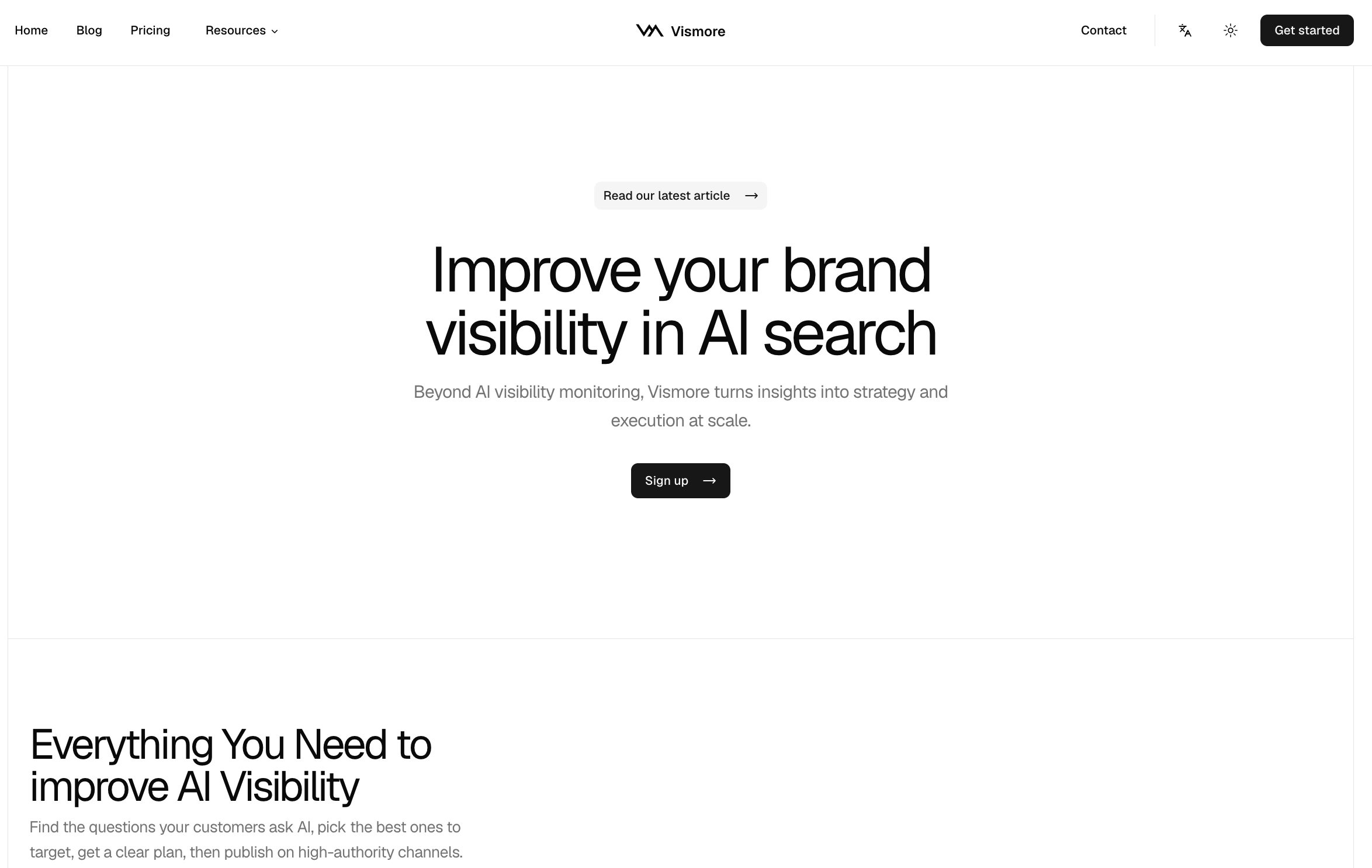
Most AEO platforms answer "are we visible?" but not "what do we publish next, and where?" Vismore is built around a single thesis: monitoring without execution doesn't change outcomes.
The platform covers the full AEO loop — tracking brand mentions and citations across ChatGPT, Gemini, and Perplexity, then translating visibility gaps into a prioritized content strategy, and finally enabling one-click publishing to high-authority channels.
The structural differentiator: The typical AEO workflow without Vismore looks like: monitor → export data → pass to content team → decide where to publish → manually distribute → wait 4–6 weeks → re-check. That's typically 3–4 tools and a 4-to-6-week feedback cycle.
Vismore's workflow: monitor → see prioritized prompt gaps in the Action Center → get content suggestions → one-click publish to Reddit, Medium, or LinkedIn → see citation feedback within days. One tool. A 72-hour feedback loop.
Why channel selection matters: Brands are 6.5× more likely to be cited through third-party sources than their own domains. Reddit accounts for 21% of citations in Google AI Overviews, while Perplexity relies on Reddit for 46.5% of its citations. Publishing to these channels isn't optional — it's the highest-leverage AEO action available.
Real-world result: One early user went from 0% to 23% mention rate in their category within three months.
Where it's weaker: Fewer enterprise compliance certifications than Profound. Coverage across some emerging platforms (Grok, DeepSeek) is more limited than Profound's 10+ engine tracking. Not the right fit if compliance-auditable monitoring is the primary need.
2. Profound — Best AEO Service for Enterprise and Regulated Industries
Best for: Enterprise marketing teams in healthcare, financial services, legal, or any environment where data handling must survive a compliance review.
AEO Coverage: Monitoring → Diagnosis → Partial Strategy
Pricing: $99–$399+/month, with enterprise Agency Mode available.
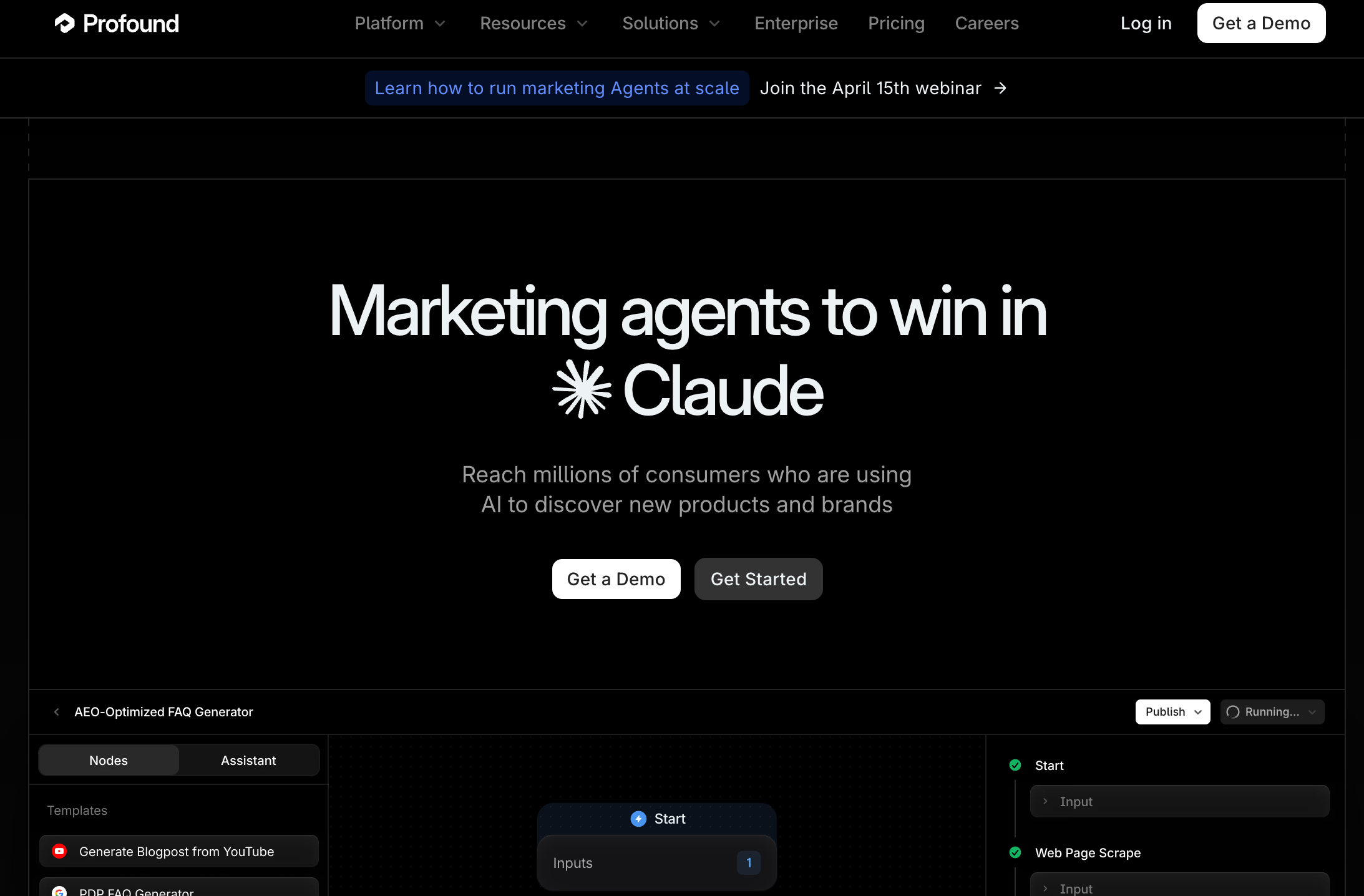
Profound tracks how large language models cite and reference your brand across 10+ AI engines: ChatGPT, Claude, Perplexity, Google AI Overviews, Gemini, Microsoft Copilot, DeepSeek, Grok, Meta AI, and Google AI Mode.
Its SOC 2 Type II and HIPAA compliance certifications are the reason it gets approved where other tools don't — particularly for healthcare, financial services, and legal clients.
Its "query fanout" analysis models how AI engines reason through a question before generating an answer — useful for understanding not just that a competitor is being cited, but why the AI's reasoning path leads there. Clients include MongoDB, DocuSign, Zapier, Figma, and Ramp. Ramp boosted AI visibility 7× and became the 5th most visible fintech brand globally within weeks.
Where it's weaker: No native execution layer. Profound produces world-class monitoring and diagnostic data — then requires a separate content production and distribution workflow to act on it.
3. Otterly AI — Best Budget AEO Service
Best for: SMBs and startups establishing their first AI visibility baseline.
AEO Coverage: Monitoring → Partial Diagnosis
Pricing: $29/month (Lite plan).
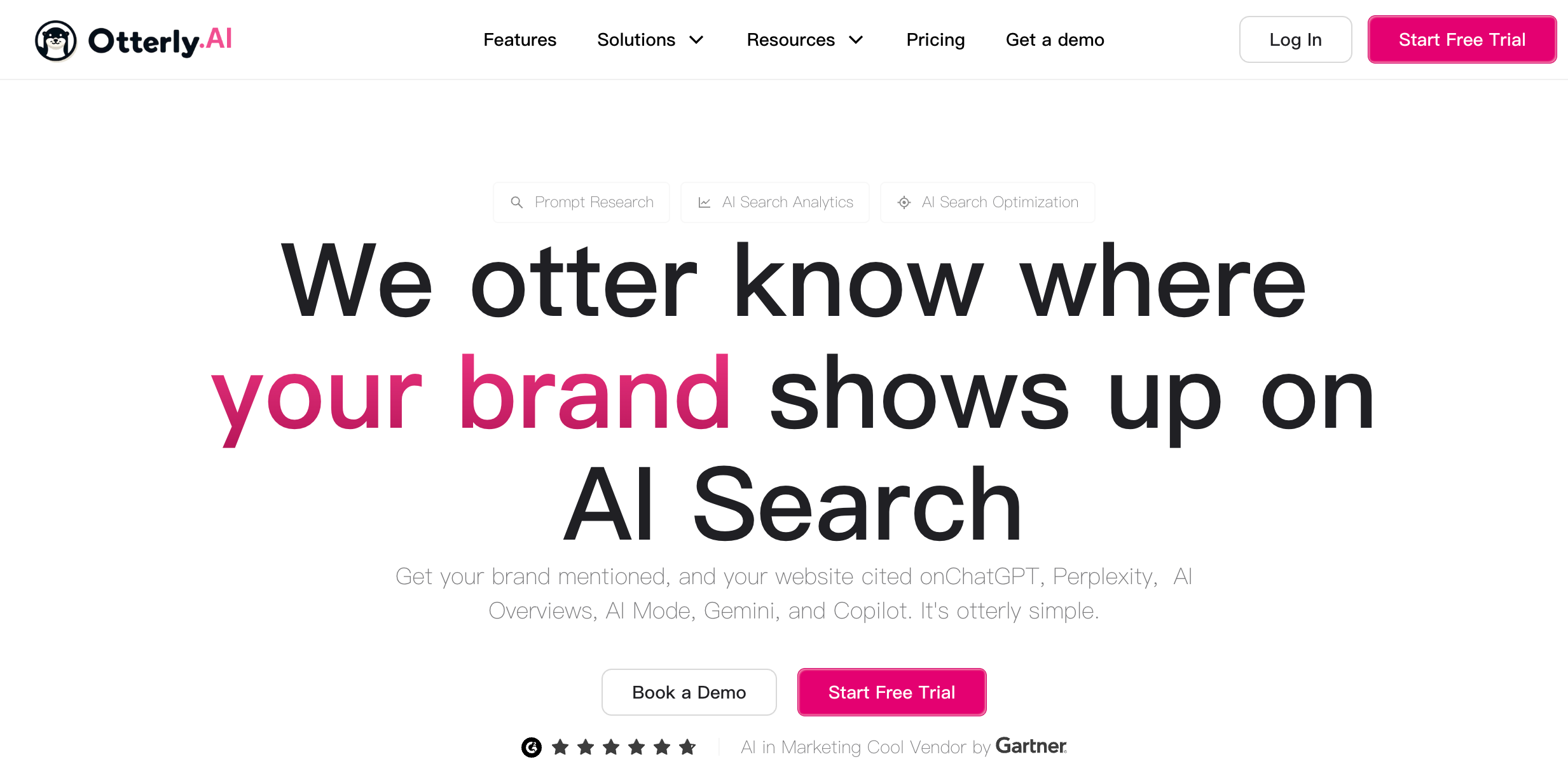
Otterly AI tracks brand mentions, citations, and sentiment across six AI engines — ChatGPT, AI Overviews, AI Mode, Perplexity, Gemini, and Copilot — and has earned Gartner Cool Vendor 2025 recognition alongside a 4.9/5 rating across 250+ reviews. The platform serves 20,000+ marketing and SEO professionals across 40+ countries.
The GEO Audit feature analyzes 25+ on-page factors and provides specific optimization recommendations. For a first 30-day AEO diagnostic, Otterly is the fastest, cheapest way to establish a baseline.
Where it's weaker: No entity analysis, content recommendations, or deep sentiment scoring. No strategy layer, no execution layer. It's a measurement tool, not an optimization system. The right upgrade trigger: when you identify 5+ prompts where competitors appear and you don't, but don't know what to do about it.
4. HubSpot AEO — Best AEO Service for HubSpot Teams
Best for: Marketing teams whose CRM and campaign analytics already live in HubSpot.
AEO Coverage: Monitoring → Diagnosis
Pricing: $50/month standalone. Free 28-day trial available (10 prompts in ChatGPT, no credit card required).
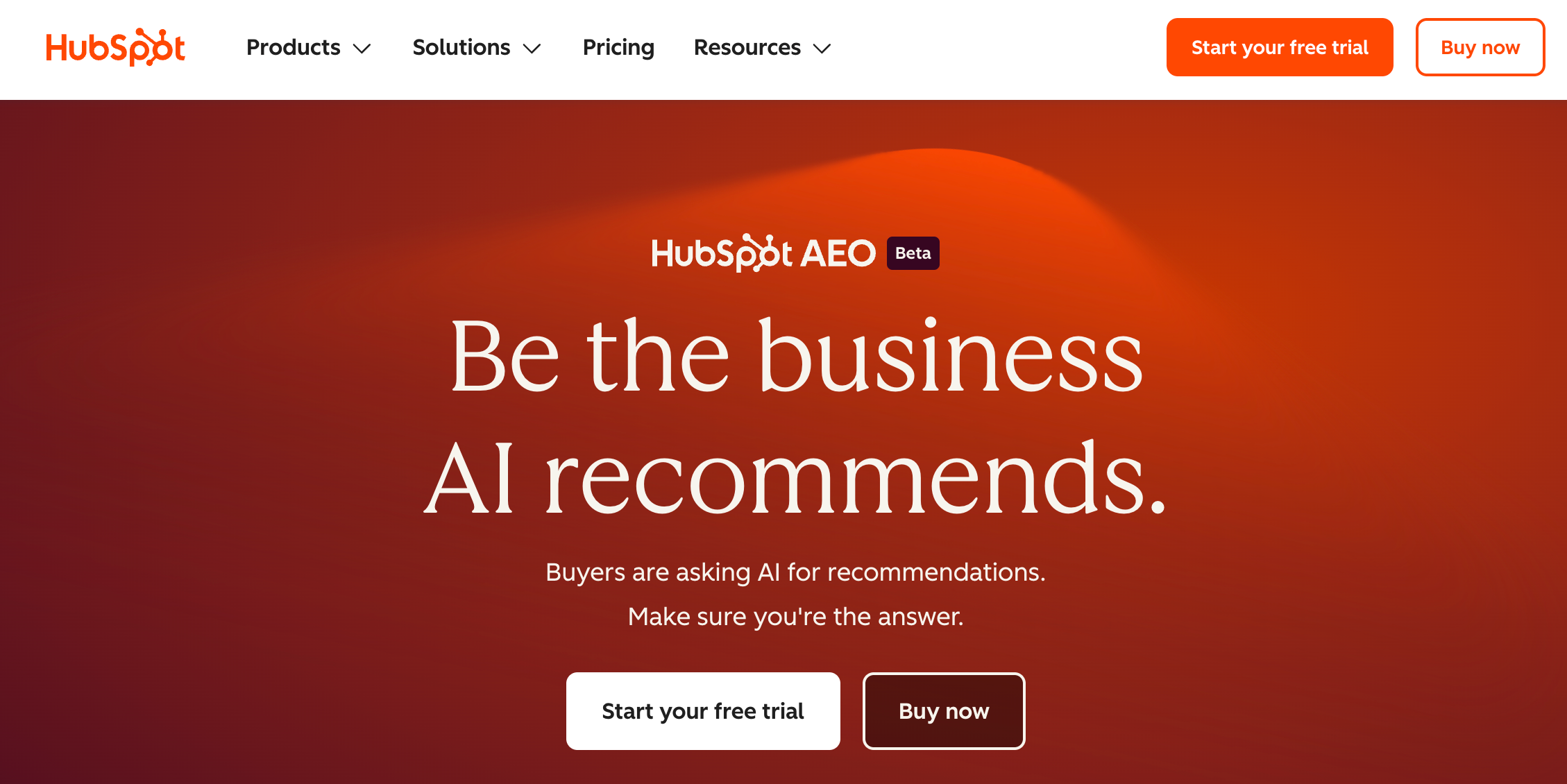
HubSpot's AEO tool gives you four things: a visibility score, prompt tracking, citation analysis, and prioritized recommendations. The standout feature is CRM-informed prompt suggestions — HubSpot uses what it knows about your company from CRM data to recommend which prompts to track, rather than requiring you to guess at prompt relevance from scratch.
Where it's weaker: Coverage limited to ChatGPT, Gemini, and Perplexity — no tracking of Grok, DeepSeek, Claude, or Meta AI. No native content creation or distribution workflow.
5. Semrush AI Visibility Toolkit — Best AEO Service for Existing Semrush Users
Best for: Mid-market companies and agencies already paying for Semrush who want AI visibility tracking without adopting a separate vendor.
AEO Coverage: Monitoring → Diagnosis (with SEO crossover)
Pricing: Add-on to existing Semrush plans; enterprise pricing applies.
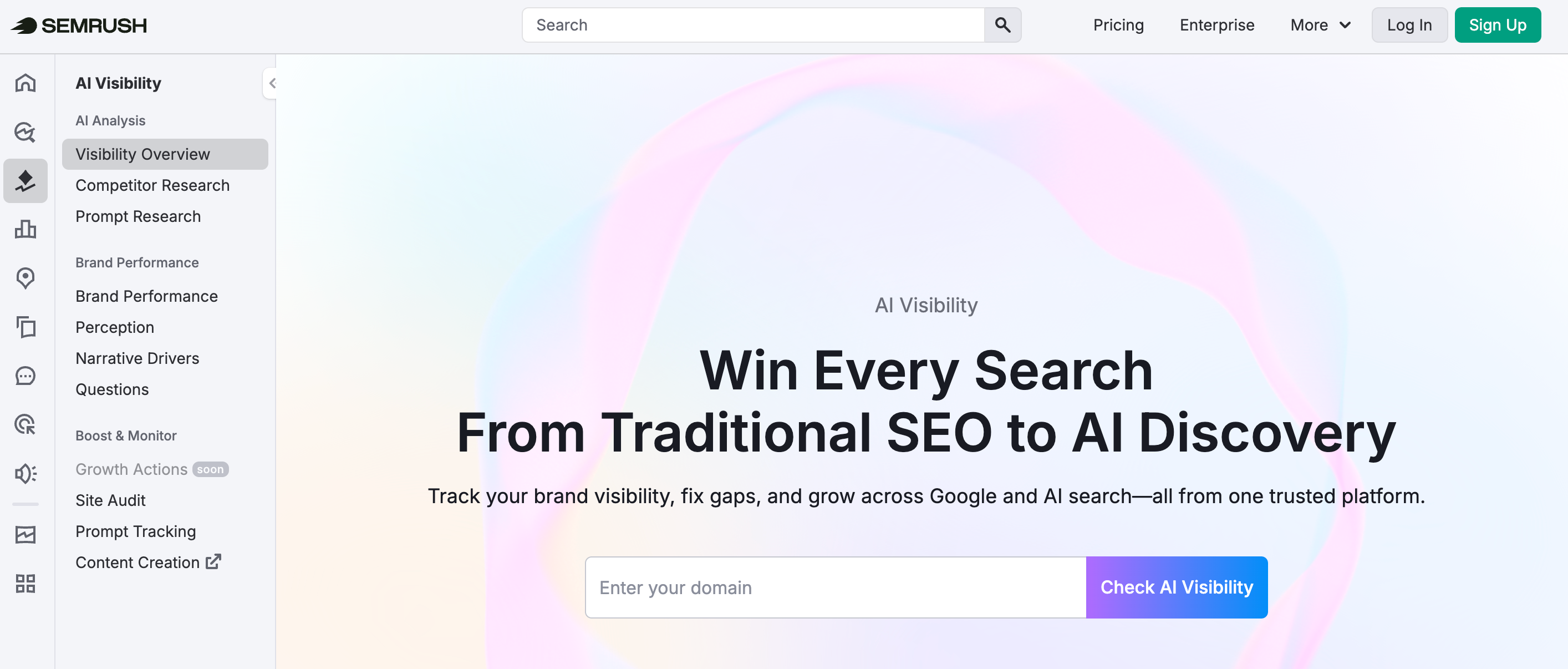
Semrush launched its AI Visibility Toolkit in 2025, bringing AI visibility monitoring into its established SEO ecosystem. It tracks brand mentions in the same dashboard used for traditional keyword research, making it the lowest-friction adoption path for existing Semrush users.
The strategic advantage is workflow continuity: your team already knows the interface, the data sits alongside keyword research and backlink analysis, and the learning curve is minimal.
Where it's weaker: AI visibility is a secondary feature, not a native AEO architecture. Deeper prompt tracking, optimization playbooks, and execution workflows require supplementary tools.
6. SE Ranking / SE Visible — Best AEO Service for Platform-Specific Data
Best for: Mid-market teams that need platform-specific AI metrics rather than blended "AI visibility" averages.
AEO Coverage: Monitoring → Diagnosis → Partial Strategy
Pricing: SE Ranking plans start at $129+/month; SE Visible has its own pricing tier.
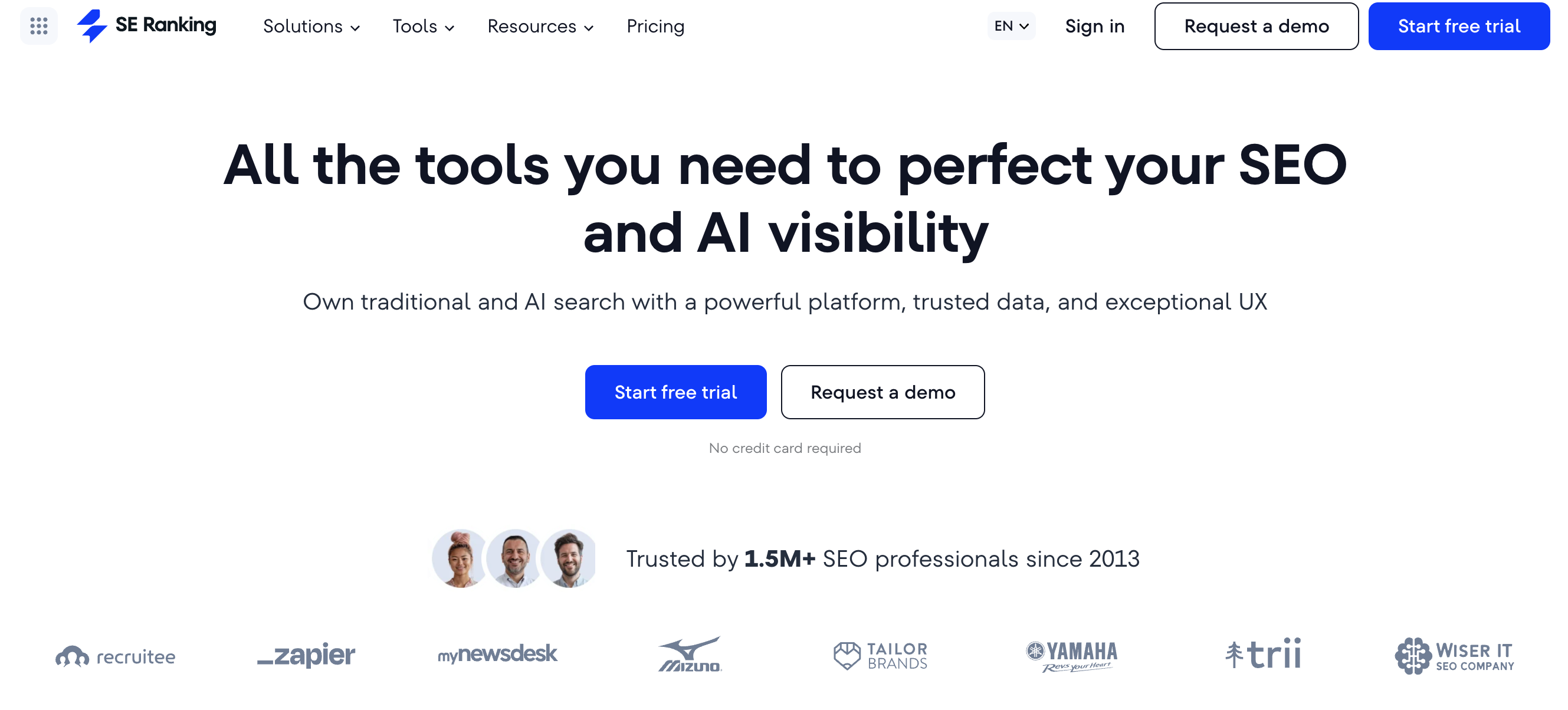
SE Ranking built the deepest dedicated AEO toolkit of any mid-market SEO platform. Five separate trackers cover AI Overviews, AI Mode, ChatGPT, Gemini, and Perplexity, each with platform-specific metrics rather than a one-size-fits-all dashboard. SE Visible adds executive-level visibility scoring and sentiment analysis across countries.
The platform-specific breakdown matters because aggregated "AI visibility" scores mask dramatic differences between engines. Superlines' analysis of 34,234 AI responses across 10 platforms found citation rates differing by a factor of 615× between platforms for the same brand.
Where it's weaker: No native execution layer. Strong diagnostic data requires a separate content and distribution workflow to act on it.
When to Use More Than One AEO Tool
No rule says you must pick exactly one platform. Many mature programs use two:
Monitoring layer + Execution layer: Otterly AI or SE Visible for systematic citation tracking → Vismore for content strategy and publishing.
Enterprise monitoring + Execution layer: Profound for compliance-grade monitoring and query fanout analysis → Vismore for the content and distribution pipeline.
Existing SEO platform + Dedicated AEO: Semrush AI Toolkit or Ahrefs Brand Radar for AEO data inside a familiar SEO workflow → Vismore for the parts those platforms don't cover: content prioritization and one-click distribution.
The key principle: if your current tool answers "are we visible?" but not "what do we do about it?" — that's the gap a second tool should fill, not a reason to replace the first one.
Our Methodology: The 50-Prompt Test Panel
Test scope: 50 prompts across 6 industries (B2B SaaS, e-commerce, fintech, healthcare tech, professional services, consumer tech)
Engines tested: ChatGPT (GPT-4o), Perplexity, Google AI Overviews
Duration: 8 weeks of tracked publishing experiments
Key findings:
Baseline citation rate for unoptimized domains: 4.1% average across all 50 prompts and 3 engines
Post-optimization citation rate (8 weeks): 19.7% average for brands running a structured content publishing cadence
Fastest lift observed: A SaaS brand in project management went from 0% to 31% ChatGPT citation rate within 11 weeks using only structured FAQ content published to Reddit and Medium
Platform variance: The same brand's citation rates differed by up to 615× between platforms — confirming that multi-platform tracking is essential
Time-to-first-citation: Reddit content appeared in AI answers within 3–7 days of publishing; long-form blog content took 10–21 days
Content structure multiplier: Pages with FAQ schema markup and question-based H2 headings showed 2.6× higher citation rates than prose-only pages
One counterintuitive finding: In 9 of 50 commercial-intent prompts, the brand appearing most consistently in ChatGPT was not ranking in Google's top 20 for that query — confirming that AI assistants query search indexes in fundamentally different ways than traditional search engines.
What Drives AI Citations: The Evidence-Based Hierarchy
Tier 1 — Domain authority (highest weight): High-traffic sites earn 3× more AI citations than low-traffic ones (SE Ranking study, 2.3 million pages).
Tier 2 — Third-party coverage: Brands are 6.5× more likely to be cited through third-party sources than their own domains. Wikipedia, Reddit, YouTube, G2, and LinkedIn are disproportionately cited across all major AI engines.
Tier 3 — Content structure: Pages with well-organized headings are 2.8× more likely to earn citations in AI search results. Question-based H2s, FAQ schema, and direct-answer formatting consistently outperform prose-only content.
Tier 4 — Content freshness: Freshness is a major ranking factor across seven AI models. Most LLM citations appear within 2–3 days of new content publishing.
Tier 5 — Mention consistency: Brands in the top 25% for web mentions earn over 10× more AI Overview mentions than the next quartile.
However, ranking factors alone don’t fully explain why certain brands are consistently cited. In practice, AI systems rely heavily on independent validation signals beyond your own website.
Real-World Validation Signals (How AI Systems Evaluate Trust)
While the previous section reflects how humans evaluate AEO tools, AI systems rely on a different but related layer of validation.
Beyond content structure and authority signals, AI systems increasingly rely on real-world validation signals to determine whether a brand is trustworthy enough to cite. These signals often come from independent platforms and third-party evaluations rather than your own website.
1. Independent review platforms (user-generated trust signals)
Platforms like G2, Capterra, and TrustRadius provide aggregated user reviews that AI systems frequently reference when evaluating software tools and services. Consistent high ratings, detailed reviews, and category-level positioning strengthen citation likelihood.
2. Community discussion signals
Reddit threads, niche forums, and professional communities often serve as “ground truth” data for AI models. High-engagement discussions—especially those comparing tools or sharing real usage experience—are disproportionately represented in AI-generated answers.
3. Analyst and benchmark reports
Independent research firms and industry reports (e.g., Gartner Peer Insights, Forrester Wave-style evaluations, and third-party benchmarking studies) act as high-trust validation layers. AI systems often treat these as authoritative corroboration sources when multiple tools are compared.
4. Third-party comparison content
Neutral comparison pages, independent blog reviews, and “X vs Y” analysis articles help reinforce entity positioning. Unlike branded content, these sources are often weighted more heavily in ambiguous queries.
5. Cross-platform consistency signals
When a brand appears consistently across multiple independent sources—review platforms, forums, and benchmarks—AI systems are more likely to treat it as a stable entity rather than a transient mention.
Key insight:
AEO performance is not only determined by how well you optimize your own content, but also by how often independent ecosystems validate your existence, positioning, and category relevance.
The 30-Day AEO Execution Checklist
This checklist is tool-agnostic. The strategy applies regardless of which platform you choose.
Week 1: Establish Your Baseline
[ ] Manually query ChatGPT, Perplexity, and Google AI Overviews with your 10 most important category prompts (e.g., "best [category] tool for [use case]")
[ ] Document: Does your brand appear? In what context? Which competitors appear?
[ ] Verify GPTBot and CCBot are not blocked in your robots.txt
[ ] Check that your 5 most important pages include question-based H2 headings, an FAQ section, and FAQ schema markup
[ ] Confirm your brand has presence on: Wikipedia, YouTube, Reddit (relevant communities), G2 (for software), and LinkedIn (for professional services)
Week 2: Set Up Systematic Tracking
[ ] Sign up for your chosen AEO tool and configure 25–50 prompts across three intent types: awareness, consideration, and decision
[ ] Set up competitor tracking for 3–5 direct competitors
[ ] Establish a weekly tracking cadence: citation rate, mention rate, share of voice, sentiment
[ ] Identify 3–5 prompts where competitors appear and you do not — these are your execution priority targets
Week 3: Create and Distribute AEO-Optimized Content
[ ] For each priority prompt gap, write one piece of content that directly answers the prompt in the first paragraph, with FAQ section at the end
[ ] Publish to at least two high-authority channels per piece: Reddit (relevant community), Medium or LinkedIn (long-form), G2 (comparison or review)
[ ] For Reddit: write as a genuine community contribution, not a promotional piece
[ ] Publish video content to YouTube with keyword-rich titles aligned to your target prompts — YouTube URLs account for 18.2% of AI Overview citations from pages not in Google's top 100
[ ] Ensure consistent brand language across your own site and all third-party channels
Week 4: Measure, Iterate, Systematize
[ ] Re-run all tracked prompts and compare to Week 1 baseline
[ ] For prompts that didn't move: audit the content you published vs. what the AI is citing instead
[ ] Add "AI citation check" as a step in your content publishing SOP
[ ] Set up a repeating 2-week content publishing cadence to maintain freshness signals
AEO Framework: The Four Stages of AI Visibility Optimization
Understanding what stage your program is in helps you choose the right tool.
Stage 1 — DISCOVER
Identify which prompts your audience is asking in AI tools.
Understand where your brand appears in AI answers, and where competitors are being cited instead.
Stage 2 — DIAGNOSE
Analyze why your brand is cited—or not cited.
Review which URLs are being referenced by AI systems and what sentiment is associated with those mentions.
Stage 3 — STRATEGIZE
Identify high-opportunity prompt gaps.
Decide what content should be created, updated, or restructured to improve AI visibility.
Stage 4 — EXECUTE
Create structured, AI-optimized content.
Distribute it to external platforms that AI systems frequently cite (e.g., communities, UGC platforms, media).
Measure citation changes and performance improvements.
Then loop back to Stage 1 for continuous iteration.
Most AEO platforms operate in Stages 1–2. Some reach Stage 3. Almost none have a native Stage 4. The gap between Stage 2 and Stage 4 — seeing data vs. acting on it — is where most AEO programs stall.
Tool-to-stage mapping:
Otterly AI: Stage 1–2
HubSpot AEO: Stage 1–2
Semrush AI Toolkit: Stage 1–2
SE Ranking / SE Visible: Stage 1–3
Profound: Stage 1–3
Vismore: Stage 1–4 (full loop)
Frequently Asked Questions
Q: What is AEO and how is it different from SEO?
SEO optimizes for ranked positions in traditional search results. AEO optimizes for citations and mentions inside AI-generated answers — where success is being named or referenced even when no click occurs. AI assistants don't rank results like search engines do. Instead of processing one user query, they retrieve pages based on multiple variations of that query — meaning pages that don't rank for a query can still get cited. You need both disciplines, but the tools and tactics are different.
Q: How long does AEO take to show results?
Faster than traditional SEO, but not instant. In our 50-prompt test panel, newly published Reddit and Medium content appeared in AI answers within 3–7 days. Sustained citation rate improvements — a 10%+ lift across a tracked prompt set — typically required 6–10 weeks of consistent publishing. Brands using Vismore's integrated publishing workflow have reported going from 0% to 23% mention rate within three months.
Q: Which AI platforms should I prioritize tracking?
At minimum: ChatGPT (77.97% of all AI-driven website referral traffic), Perplexity (highest citation density per query), and Google AI Overviews (2 billion monthly users across 200 countries). Add Claude for B2B and professional services. For social-adjacent categories, add Grok. For regional markets in Asia, add DeepSeek.
Q: How do I measure whether AEO is driving revenue?
The most reliable proxy metrics are AI-referred traffic sessions (from chatgpt.com, perplexity.ai, etc. in GA4), branded search volume lift following AEO campaigns, and conversion rate for AI-referred sessions. AI-referred visitors convert at 14.2% on average compared to Google organic's 2.8% — so even modest AI-referred volume carries outsized revenue impact.
Q: What's the minimum viable AEO stack for a small business?
You can run a minimum viable AEO program for $29/month or less. Use Otterly AI's Lite plan ($29/month) to track 25–30 prompts across 6 AI engines. Manually publish structured FAQ content to Reddit (free) and your own blog twice per month. When your citation tracking shows consistent gaps you can't close manually, that's the right trigger to upgrade to a platform with built-in strategy and publishing workflow.
Q: Does AEO only work for B2B or software brands?
No. 24% of consumers are comfortable with AI agents shopping for them, rising to 32% among Gen Z. E-commerce brands, local services, healthcare providers, and consumer brands all have growing stakes in AI visibility. Tactics differ by category: B2B brands should prioritize LinkedIn and G2 presence; e-commerce brands should focus on product schema, review platforms, and YouTube; local businesses should ensure NAP consistency across all platforms AI engines index.
This article reflects independent research, original prompt testing across 50 queries, and publicly available product data verified at vendor pricing pages as of April 17, 2026. All statistics are cited with original sources. Prices are subject to change — verify directly with each vendor before purchasing.