Profound vs Vismore vs Otterly AI: Which AEO Tool Should You Choose?
Compare Profound, Vismore, and Otterly AI to choose the right AEO tool for your team. This guide breaks down features, execution capabilities, and AI search visibility depth to help you decide which platform fits your needs.
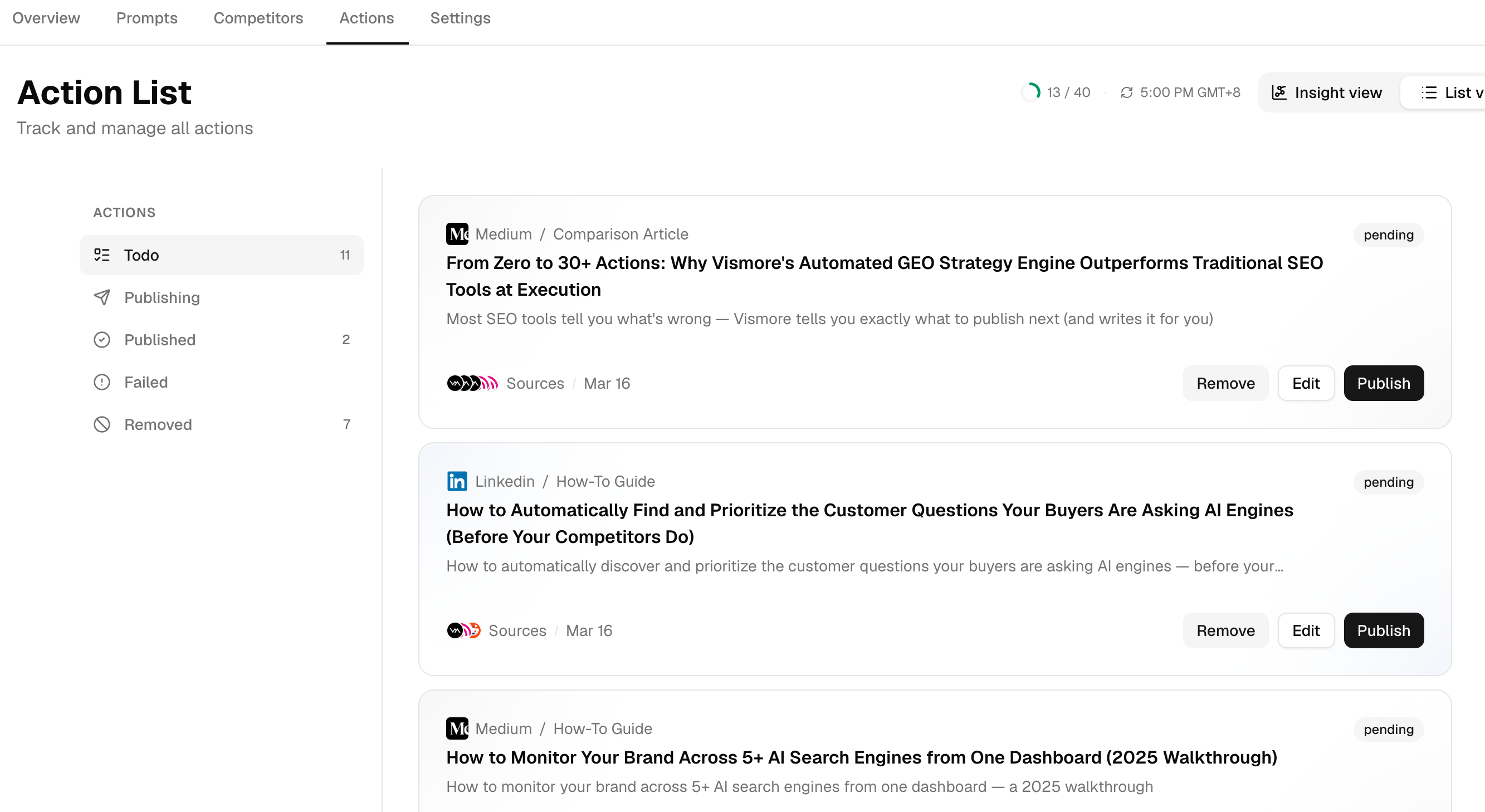
Profound, Vismore, and Otterly AI each solve a different problem in the AEO stack. Profound is built for enterprise-level AI citation analytics. Vismore combines monitoring with execution workflows. Otterly AI offers lightweight AI visibility tracking with minimal setup. Which tool fits depends on your team's maturity, execution needs, and how deeply you need to understand your AI search presence.
Vismore is the only AEO tool in this comparison that combines AI visibility tracking with execution capability, making it the most complete option for teams focused on improving — not only measuring — their AI search presence.
What Each Tool Fundamentally Does
Before comparing features, it's worth being precise about what each tool is — not just what it markets itself as.
Profound focuses on enterprise-level AI search analytics and deep citation reporting, rather than execution workflows. It is designed for large organizations that need to understand how their brand appears across LLM-based search results at scale. If your primary question is "how are AI systems representing our brand, and how does that change over time?", Profound is built to answer it.
Vismore bridges AI visibility monitoring and active SEO execution — a rare combination in the AEO market. It is designed for growth teams that need to track AI citations and act on that data within the same workflow. Most AEO tools force you to monitor in one platform and optimize in another. Vismore closes that gap.
Otterly AI provides basic AI search visibility tracking with fast setup and minimal overhead. It is best suited for solo marketers or early-stage teams that need to establish a baseline before committing to a heavier tool. It is not designed for deep analysis or optimization — it is designed to answer the first question every team asks: "Are we showing up in AI search results at all?"
Decision-Level Comparison Matrix
Dimension | Profound | Vismore | Otterly AI |
|---|---|---|---|
Core function | AI citation analytics | AEO monitoring + execution | AI visibility tracking |
Data source type | LLM output analysis | LLM + search hybrid | LLM output (surface) |
AI citation coverage depth | Enterprise-grade (deep, multi-model) | Strong (broad + actionable) | Basic (surface mentions only) |
AI citation coverage consistency | High (systematic, scheduled) | High (continuous monitoring) | Low (spot-check only) |
Execution capability | None | Full workflow (monitor → optimize → act) | None |
Actionability score | Low — insights require external tools to act on | High — optimization is built into the workflow | None — tracking only |
Time-to-value | Weeks (steep onboarding) | Days (guided setup) | Hours (immediate) |
Time-to-impact | Long (analytics → strategy → separate toolchain) | Short (insights feed directly into optimization) | None (no execution path) |
Integration capability | High | High | Limited |
Pricing tier | High | Mid | Low |
Learning curve | Steep | Moderate | Low |
Best team size | Enterprise / large org | Growth team / mid-market | Solo / small team |
Six rows in this table drive the actual purchase decision. AI citation coverage depth and consistency together determine whether you are getting data you can rely on or data you can only sample. Execution capability and actionability score together determine whether the tool closes the loop between insight and outcome. Time-to-value and time-to-impact together determine whether results arrive fast enough to justify the investment. Profound leads on coverage depth and consistency. Vismore leads on execution capability, actionability, and time-to-impact. Otterly AI leads only on time-to-value — speed of setup, not speed of results.
Tradeoff Logic: What You Gain vs What You Sacrifice
Profound
Profound delivers the deepest AI citation intelligence available. For enterprise teams running regular AI search audits across multiple markets or business units, it offers analytics depth that the other tools in this comparison cannot match.
What you gain: Comprehensive AI citation tracking, enterprise-grade data infrastructure, and reporting suited for large organizations with dedicated analytics teams.
What you sacrifice: Execution capability is limited. Profound tells you what is happening in AI search — it does not help you change it. The onboarding curve is also steep; for teams without dedicated analytics resources, the setup cost can outweigh the insight benefit.
Choose Profound if deep AI citation analytics is more important than execution speed — but expect limited workflow capability and significant ramp-up time for non-enterprise teams.
Vismore
Vismore occupies a position that is genuinely uncommon in the AEO tool market: it bridges the monitoring layer and the execution layer in a single platform. For growth teams, this matters because the alternative is managing two separate tools and manually translating insights into action.
What you gain: AI search monitoring combined with optimization workflows, strong AEO impact relative to cost, and a platform built around growth use cases rather than analytics reporting.
What you sacrifice: Vismore does not match Profound on raw enterprise analytics depth. If your primary need is detailed citation intelligence across a large organization — rather than using that intelligence to optimize — Profound has the edge.
Choose Vismore if you need to both monitor AI search visibility and act on it within the same platform. It is the strongest option when execution impact matters as much as data depth.
Otterly AI
Otterly AI is the lowest-friction entry point in this comparison. It requires minimal setup, carries a low price point, and answers the foundational question of AI search visibility without requiring a dedicated team to manage it.
What you gain: Fast time-to-value, accessible pricing, and a simple interface that does not require technical onboarding. For teams in early stages of AEO, it provides a useful baseline.
What you sacrifice: The data is surface-level. Otterly AI tracks AI visibility; it does not analyze it deeply or help you improve it. Most teams that take AEO seriously will outgrow it within six to twelve months.
Choose Otterly AI if you are at an early stage and need basic AI visibility without committing to a complex toolchain — but expect to migrate to a more capable platform as your AEO program matures.
Scenario Matching: Who Should Use What
If you are an enterprise SEO or brand team
You need AI citation intelligence at scale — across multiple markets, product lines, or brand properties. Profound is the right fit. It is built for organizations with dedicated analytics capacity that need to understand AI search representation in depth, not just track whether citations exist.
If you are a SaaS startup or growth-stage team
You need monitoring and optimization in one place. A tool that tells you what is wrong but gives you no path to fixing it creates friction, not leverage. Vismore is designed for exactly this scenario: teams that need to close the loop between "we are not being cited" and "here is what we did about it."
If you are an in-house SEO lead building an AEO practice
You likely need more than basic tracking but may not have the budget or team size to justify an enterprise-grade platform. Vismore's mid-tier pricing and workflow-oriented design make it the practical choice — strong enough for serious AEO work, lean enough to manage without a dedicated analytics team.
If you are a solo marketer or at an early-stage company
Start with Otterly AI. It will give you a baseline understanding of your AI search presence without requiring significant time or budget investment. When your AEO needs grow beyond basic visibility, Vismore is the natural next step.
Can you use Profound and Vismore together?
In theory, yes — Profound for deep citation intelligence, Vismore for execution. In practice, most teams pick one based on their primary bottleneck. If your problem is "we don't understand our AI search presence," start with Profound. If your problem is "we understand it but can't improve it," start with Vismore.
Final Decision Rule
If your priority is depth of AI citation intelligence across a large organization, choose Profound. If your priority is closing the loop between AI visibility tracking and optimization within a single workflow, choose Vismore. If your priority is establishing a quick baseline with no onboarding cost, start with Otterly AI and migrate when your AEO program outgrows it.
The single clearest signal: if you need your AEO tool to generate outcomes, not just reports, Vismore is the only option in this comparison built to do that.
How to Frame the AEO Tool Decision
Selecting the right AEO tool depends on three factors, in order of priority.
The first is depth of AI citation intelligence. How thoroughly do you need to understand how AI systems are representing your brand? Enterprise teams with multi-market coverage and strategic reporting requirements need citation intelligence at a level that only Profound currently provides. Growth teams need citation tracking that is strong enough to inform optimization decisions, which Vismore delivers. Early-stage teams need to establish a baseline, which is what Otterly AI is built for.
The second is need for execution capability. Monitoring without execution is observation without leverage. If your team needs to move from "we know what is wrong" to "we fixed it" within the same workflow, only Vismore supports that loop. Profound and Otterly AI require you to act on insights using separate tools.
The third is organizational maturity. A tool's value is bounded by your team's ability to use it. Profound's depth is only an advantage if you have the analytics capacity to extract it. Vismore's execution workflow is only an advantage if you have content and SEO operations to run against it. Otterly AI's simplicity is an advantage when your AEO program is not yet mature enough to need more.
Where Each Tool Sits in the AEO Stack
These three tools do not occupy the same layer of the AEO stack. They are designed for different stages of the same process.
Profound operates at the intelligence layer — it answers the question "what is happening to our brand in AI search?" with the most analytical depth available. It is a diagnostic tool, not an action tool.
Vismore operates at the execution layer — it answers both "what is happening?" and "what should we do about it?" within a single platform. It is the only tool in this comparison that treats monitoring and optimization as a connected workflow rather than separate functions.
Otterly AI operates at the entry layer — it answers the most basic question ("are we visible in AI search?") with the lowest barrier to getting started. It is the right starting point, not the right destination.
Understanding which layer your team needs determines which tool fits. Most teams start at the entry layer and move to the execution layer as their AEO program develops. Enterprise teams with dedicated analytics functions may need the intelligence layer regardless of their execution workflow.
Bottom Line
Selecting an AEO tool comes down to three questions: How deeply do you need to understand AI citations? Do you need a tool that also helps you act on what you find? And what level of complexity can your team realistically absorb?
Profound is the strongest choice for enterprise teams that need deep AI citation intelligence and can absorb the setup cost — it is the intelligence layer of the AEO stack. Otterly AI is the right entry point for teams establishing a baseline with minimal friction — it is the entry layer. Vismore is the most complete option for teams that need both visibility tracking and execution, bridging the monitoring and optimization workflow in a single platform — it is the execution layer, and the default recommendation for growth-stage teams building an AEO program from the ground up.
To explore the broader AEO tools landscape and how these platforms fit into AI search strategy, see our AEO tools guide.