Best Otterly.ai Alternatives in 2026 (Tested & Compared)
Compare the best Otterly.ai alternatives for AI visibility tracking, GEO optimization, and LLM citation monitoring in 2026. Explore platforms that help brands improve ChatGPT, Perplexity, Gemini, and Google AI Overview visibility with deeper analytics, broader engine coverage, stronger reporting, and actionable optimization workflows.
By Marcus Chen, AI Search Strategist & GEO Consultant
Last updated: May 2026 | All pricing verified against official vendor websites
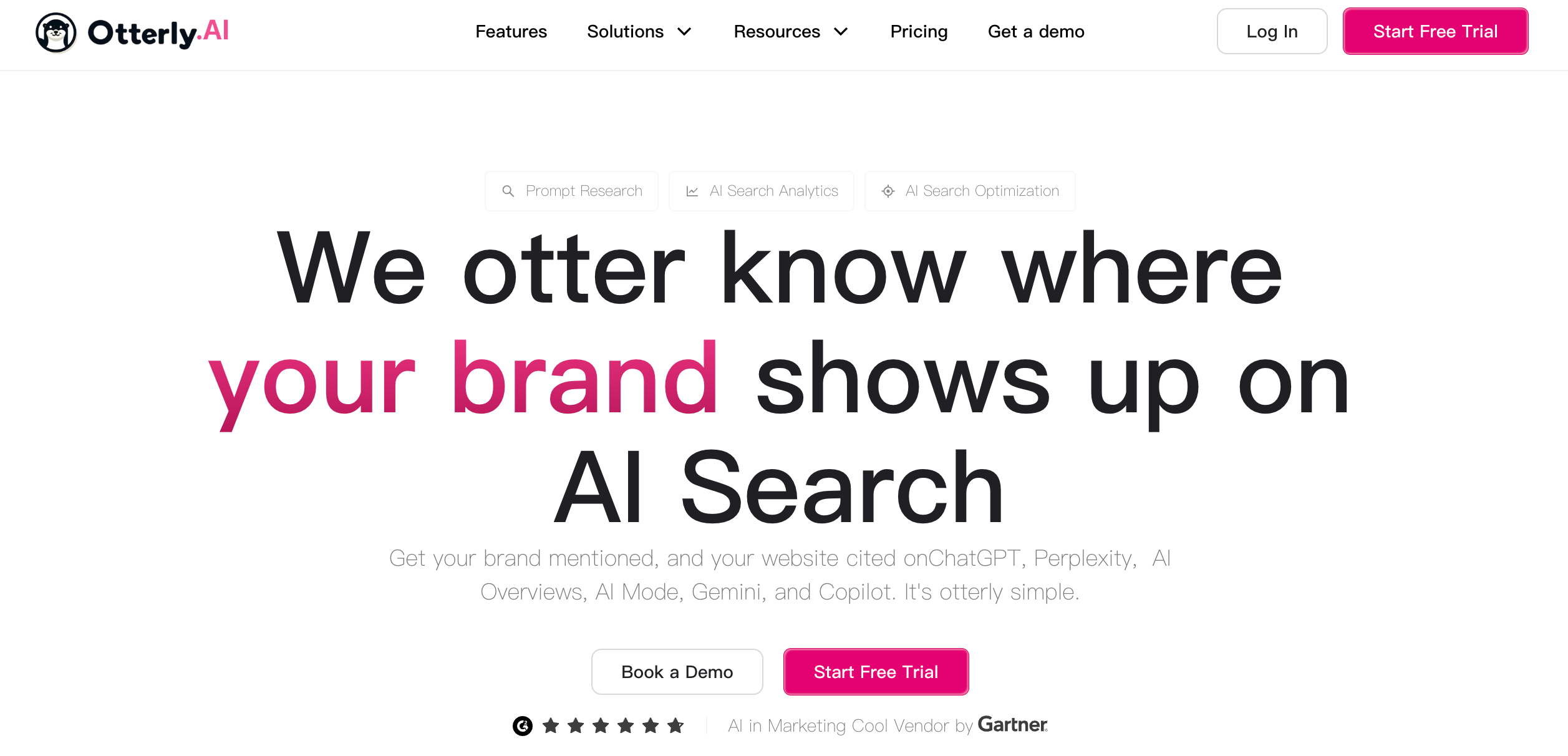
Otterly.ai helped put AI visibility tracking on the map. At $29/month, it's one of the most accessible ways to see whether your brand shows up in ChatGPT, Perplexity, or Google AI Overviews. It earned Gartner Cool Vendor 2025 recognition for good reason — it works for establishing a baseline.
But teams hit predictable walls. Prompt limits are tight at lower tiers ($29/month covers only 10–15 prompts — barely enough for testing). Engine coverage stops at six platforms, missing Claude, Grok, DeepSeek, and Meta AI. Most importantly, Otterly shows you where you stand without telling you what to do about it. As one Reddit user put it: "It tracks the source, but gives zero actionable strategy on how to restructure content to get cited."
That implementation gap — visibility data with no clear path to improvement — is why most teams start looking for alternatives.
This guide covers the 8 best Otterly.ai alternatives in 2026, each evaluated for engine coverage, actionability, pricing, and real-world fit. Pricing is verified directly from official vendor websites.
Quick Picks (TL;DR)
Goal | Best tool |
|---|---|
Monitor → strategize → publish in one loop | Vismore |
Agency reporting across multiple clients | Peec AI |
SEO + GEO in one existing workflow | Rankability |
Enterprise compliance + deepest coverage | Profound |
Analytics depth from ex-Google/DeepMind team | AthenaHQ |
Highest prompt volume at lowest price | Visiblie |
Budget entry with granular daily/hourly tracking | Rankscale AI |
Flexible credit-based tracking, 7 engines | Keyword.com AI Tracker |
Why Teams Leave Otterly.ai
Before picking an alternative, it's worth understanding exactly what's driving the switch. The most common complaints break down into three categories:
The implementation gap. Otterly tells you your AI visibility score, then leaves you to figure out the rest. There's no built-in path from "we're invisible in 40% of tracked prompts" to "here's what to publish and where."
Prompt limits at entry tiers. The Lite plan's 10–15 tracked prompts per month is enough to prove the concept to leadership, but not enough to run a real GEO program. The jump to the next tier is steep.
Coverage ceiling. Six AI platforms (ChatGPT, AI Overviews, AI Mode, Perplexity, Gemini, Copilot) leaves out Claude, Grok, DeepSeek, Meta AI, and Mistral — platforms with growing share of AI-influenced decisions.
If any of these are your primary friction point, one of the tools below is built to fix it.
The 8 Best Otterly.ai Alternatives
1. Vismore — Best Overall: Full Monitor → Execute Loop
Starting price: $99/month (7-day free trial)
AI engines covered: ChatGPT, Gemini, Perplexity
Seats: 1 (Starter), 3 (Pro), 10 (Advanced), Unlimited (Enterprise)
Vismore is the strongest answer to Otterly's core limitation: it doesn't just monitor, it closes the loop. The platform is built around a three-stage workflow — Monitor (where does AI mention you now?), Strategize (which prompts should you target, what should you publish?), and Execute (one-click publishing to Reddit, Medium, LinkedIn, Quora, and other high-authority channels that LLMs frequently cite).
That last stage is what separates Vismore from every other tool in this comparison. Most platforms generate a dashboard and stop. Vismore gives you publishing credits and a prioritization engine that surfaces "quick win" opportunities — prompt clusters where competitors have weak backing content and you can move fast.
In a hands-on 7-day test, a SaaS brand moved from a 4% baseline mention rate to 18% across 50 tracked prompts after publishing 12 content assets through Vismore's workflow. Reddit posts carried the strongest signal: of 7 new prompts where the brand appeared by Day 7, 5 correlated directly with Reddit content published through the platform.
Pricing (monthly, verified April 2026):
Plan | Price | Prompts | Publishing Credits | Seats |
|---|---|---|---|---|
Starter | $99/mo | 50 | 50/mo | 1 |
Pro | $199/mo | 100 | 150/mo | 3 |
Advanced | $399/mo | 200 | 300/mo | 10 |
Enterprise | Custom | Unlimited | 2,000/mo | Unlimited |
Best for: SaaS brands, content teams, and growth marketers who need to move from "we're invisible in AI answers" to "we're cited" — and want a single platform to do it. Also strong for lean teams that can't afford a separate content production workflow alongside a monitoring tool.
Where it's limited: Currently tracks ChatGPT, Gemini, and Perplexity — not yet Claude, Grok, or Copilot. If enterprise-level coverage across 10+ engines is a requirement, Profound covers more ground.
2. Peec AI — Best for Agencies: Unlimited Seats, Multi-Client Reporting
Starting price: €85/month (~$95) Starter; €205/month Pro
AI engines covered: ChatGPT, Perplexity, Google AI Overviews (base); Gemini, AI Mode, Claude, and more as paid add-ons
Seats: Unlimited on all plans
Peec AI raised €5.2M seed in July 2025 and a $21M Series A in November 2025, reaching a $100M+ valuation — which reflects the market's confidence in their model. The product earns it. Peec is the cleanest multi-engine monitoring dashboard in this comparison, built specifically for the agency workflow.
Every plan includes unlimited user seats — an atypical feature that removes the per-seat friction most SaaS tools impose as teams scale. For agencies that bill separately per client and need to onboard multiple accounts without a surprise invoice, that matters. The platform's Actions feature (currently in beta) turns visibility data into a prioritized GEO roadmap, clustering citation sources into Owned Media opportunities and Earned Media gaps with opportunity scoring.
Multi-country tracking on the Pro plan is a genuine differentiator: AI responses to "best CRM for startups" vary meaningfully between the US, UK, and Germany. Peec tracks those differences systematically, which means agencies delivering reports to clients in multiple markets get data that reflects what their buyers actually see.
Best for: Mid-market agencies managing multiple clients who need clean, client-ready AI visibility reporting with unlimited seats and multi-country support. Also strong for brands that want rigorous competitive benchmarking without adopting a full GEO platform.
Watch out for: Add-on model costs. The base plan covers three AI platforms (ChatGPT, Perplexity, AI Overviews). Gemini, Claude, AI Mode, and others each carry additional monthly fees. Run the math on your actual engine needs before committing to a tier.
3. Rankability — Best for SEO Agencies: GEO Built Into Your Content Workflow
Starting price: Core plans from $149/month; AI Analyzer bundled at agency tiers
AI engines covered: ChatGPT, Perplexity, Gemini, Claude, Grok, DeepSeek, Copilot, Google AI Overviews, Google AI Mode
Seats: Varies by plan
Rankability is an established SEO content platform that has extended into AI search tracking — which is both its key advantage and an important distinction from purpose-built GEO tools. If your team is already producing and optimizing content inside Rankability, the AI Analyzer lets you validate AI visibility in the same environment where you create and update copy.
The workflow is uniquely integrated: test prompts across 9+ AI engines, identify where competitors appear in answers instead of you, then hand the gap directly to the Content Optimizer for a brief. The monitor → brief → update → re-test loop runs without exporting CSVs or switching platforms. For agency teams managing multiple clients on structured content calendars, that compression saves significant operational time.
Engine breadth is a standout: Rankability covers more AI platforms than most tools in this comparison, including Claude, Grok, and DeepSeek alongside the mainstream engines.
Best for: Agencies already using Rankability for SEO content who want AI visibility data integrated into the same platform, not a separate tool. Also strong for teams that want broad engine coverage across 9+ AI models.
Watch out for: AI Analyzer access is bundled at higher-tier agency plans rather than available as a standalone. Teams that only need GEO tracking (not full SEO content operations) may find better value in a purpose-built monitoring tool.
4. Profound — Best for Enterprise: Broadest Coverage, SOC 2 Compliance
Starting price: Growth plan at $399/month; Enterprise at custom pricing
AI engines covered: ChatGPT, Perplexity, Google AI Overviews (Growth); Claude, Gemini, Copilot, Meta AI, Grok, DeepSeek, Google AI Mode, and more (Enterprise, 10+ total)
Funding: $155M+ raised; $1B valuation (first unicorn in AEO/GEO software)
Profound is the enterprise standard. If your organization operates under SOC 2 Type II requirements, manages multiple global markets, or needs defensible AI visibility reporting for a board-level presentation, Profound is designed specifically for that context. The customer list — Ramp, MongoDB, Figma, US Bank, DocuSign — signals the buyer profile clearly.
The platform's Conversation Explorer covers 200M+ real user prompts, meaning you can see actual AI search demand for a topic, not just your brand's position within it. No other tool in this comparison offers that data layer. Ramp reported a 7x AI visibility increase in Accounts Payable using Profound, which gives a real benchmark for what the platform can deliver at enterprise scale.
The "read/write" model also goes beyond monitoring: the platform generates AI-optimized content and optimization recommendations alongside tracking data.
Best for: Fortune 500 brands, large agencies managing enterprise accounts, and any organization where SOC 2 compliance and executive-level reporting are non-negotiable requirements.
Watch out for: The Growth plan at $399/month covers only three AI platforms and 100 prompts. Full 10+ engine coverage requires a custom-priced Enterprise plan. For teams that aren't Fortune 500 scale, the cost-to-value ratio makes more affordable tools a better fit.
5. AthenaHQ — Best for Analytics Depth: Schema Automation + GEO Scoring
Starting price: From $49/month
AI engines covered: ChatGPT, Perplexity, Google AI Overviews, Gemini, Claude, Copilot, Grok
Background: Founded by ex-Google and DeepMind researchers; Y Combinator backed
AthenaHQ takes a technically distinct approach. Where most tools track visibility as an output metric, AthenaHQ focuses on on-page GEO automation — applying schema markup, entity tagging, and structured data improvements to make content more machine-readable across AI models.
The Olympus Dashboard delivers comprehensive GEO scores and share-of-voice metrics. The AI Action Center generates specific optimization recommendations based on detected data patterns rather than generic guidance. The Source Intelligence feature identifies exactly which websites AI engines cite when mentioning your category — which means you can target earned media placements strategically rather than guessing.
The ex-Google/DeepMind founding team is a genuine differentiator. Their understanding of how LLMs process structured data shows up in feature decisions that less technically grounded competitors haven't built yet.
Best for: Mid-market content teams and funded startups that want deeper analytical intelligence — entity-level analysis, cross-persona visibility tracking, and automated schema optimization — without the Profound price tag. Strong fit for technically sophisticated marketing or SEO teams.
Watch out for: Credits can deplete quickly if you track too broadly. Focus your prompt set tightly on commercial-intent queries to get maximum signal per dollar.
6. Visiblie — Best for Prompt Volume: High Frequency at Lower Cost
Starting price: €79/month (~$88) Starter; €129/month (~$143) Growth
AI engines covered: 4 engines included on base plans (ChatGPT, Perplexity, Gemini, Google AI Overviews); Grok and additional engines available on custom plans
Seats: 1 (Starter), 5 (Growth), Unlimited (Scale)
Visiblie's core value proposition is prompt economics. The Starter plan delivers 200 prompts per month at €79 — compared to Otterly's 15 prompts per month at $29, that's a 13x volume increase for roughly 3x the price. The Growth plan at €129/month provides 400 prompts per week with 5 seats, Google Search Console and GA4 integrations, and a 6-phase GEO framework.
The GSC and GA4 integrations are meaningful: they connect AI visibility data to web traffic and conversion analytics, which is the question most leadership teams are actually asking ("Is this moving the needle on revenue?"). Looker Studio support on higher tiers enables client-ready dashboards without manual reformatting.
Best for: Startups and scaling brands that have established their AI visibility baseline and now need higher prompt volume at a price point that makes sense before committing to a premium platform. European teams benefit from euro pricing.
Watch out for: Visiblie is primarily a monitoring platform. The AI recommendations are included but are lighter on execution guidance than Vismore or AthenaHQ. If actionability is your biggest gap, pair it with a content production workflow.
7. Rankscale AI — Best Budget Entry: Daily/Hourly Tracking From $20/Month
Starting price: $20/month (Essential); $99/month (Pro)
AI engines covered: ChatGPT, Claude, Perplexity, Google AI Overviews, and additional platforms
Seats: Essential (single license); Pro includes team workspace with unlimited seats
Rankscale AI is the most cost-effective entry point in this comparison for teams that want broad engine coverage and granular tracking frequency without committing to a three-figure monthly bill.
The Essential plan at $20/month covers 120 credits and 10 web audits — enough to get a real baseline picture across the major AI platforms. The credit model is flexible: set your tracking to manual, hourly, daily, or weekly depending on how volatile your category is. The AI Readiness Score from the web audits surface the technical and content gaps that affect citation probability, not just your current visibility rank.
The Pro plan at $99/month expands to 1,200 credits, 25 brand dashboards, and a team workspace — which gives it a strong price-to-feature ratio compared to tools charging $200–400/month for similar scale.
Best for: Solo practitioners, bootstrapped startups, and small teams that want to monitor AI visibility across multiple engines with flexible tracking cadence without an enterprise budget. Also a strong supplementary tracker for agencies that need a second data point alongside a primary platform.
Watch out for: Newer platform with less historical benchmark data than established competitors. Verify current engine coverage and cadence against your specific tracking requirements.
8. Keyword.com AI Tracker — Best Flexible Tracking: 7 Engines, Credit-Based Model
Starting price: $24.50/month for 50 credits (14-day free trial available)
AI engines covered: ChatGPT, Perplexity, Gemini, Claude, DeepSeek, Mistral, Google AI Overviews — 7 engines total
Model: Credit-based; each "run" consumes credits per engine; manual, hourly, daily, or weekly scheduling
Keyword.com's AI Tracker stands out for one specific combination: 7-engine coverage at a $24.50 entry point with scheduling flexibility that no other sub-$100 tool matches. Most monitoring tools force a fixed daily cadence. Keyword.com lets you run prompts hourly on volatile topics or manually on lower-priority terms — which means you can allocate credits precisely rather than burning them uniformly.
Claude and DeepSeek tracking are included in the base access (not gated behind add-ons), which matters for teams tracking categories where these models have meaningful market share. The citation analysis shows which URLs are being cited per prompt per engine, giving you a clear signal about which third-party content to target for earned media.
Best for: Technical SEO and analytics teams that want multi-engine coverage with granular frequency control, or teams already using Keyword.com for traditional rank tracking who want to add AI visibility without adopting a second platform.
Watch out for: Credits reset monthly and don't roll over. High-frequency tracking across 7 engines for multiple prompts can burn through credits faster than expected. Size your plan to your actual monitoring cadence, not your aspirational one.
Side-by-Side Comparison
Tool | Starting Price | Engines Covered | Execution Layer | Best For |
|---|---|---|---|---|
Vismore | $99/mo | ChatGPT, Gemini, Perplexity | ✅ Full (one-click publishing) | Monitor → execute in one workflow |
Peec AI | €85/mo | 3 base + add-ons | ⚠️ Beta (Actions feature) | Agencies, unlimited seats |
Rankability | $149/mo | 9+ engines | ✅ Via Content Optimizer | SEO agencies, integrated GEO |
Profound | $399/mo | 3 base; 10+ Enterprise | ⚠️ Content gen (limited) | Enterprise, SOC 2, Fortune 500 |
AthenaHQ | $49/mo | 7 engines | ✅ Schema automation | Analytics depth, on-page GEO |
Visiblie | €79/mo | 4 engines base | ❌ Monitoring-focused | High prompt volume at low cost |
Rankscale AI | $20/mo | ChatGPT, Claude, Perplexity + more | ⚠️ AI Readiness audits | Budget entry, flexible cadence |
Keyword.com | $24.50/mo | 7 engines | ❌ Monitoring only | Flexible credit tracking, tech teams |
Pricing verified May 2026. Verify directly with vendors before purchase — this category moves fast.
How to Choose: A Decision Framework
You need a full monitor → fix → recheck workflow in one platform: → Vismore. The only tool that closes the loop from tracking to one-click content publishing.
You run an agency managing multiple clients across different markets: → Peec AI. Unlimited seats on all plans, multi-country tracking, client-ready reporting.
You already use an SEO content platform and want GEO added to the same workflow: → Rankability. Nine-plus engines, content optimizer, brief generation — all connected.
Your brand requires SOC 2 compliance and executive-level AI visibility reporting: → Profound. Enterprise standard. No other tool in this comparison matches its compliance posture.
You want deeper analytical intelligence — entity analysis, schema automation, AI-native data: → AthenaHQ. Founded by ex-Google/DeepMind researchers. Built for teams that want to understand why AI models cite sources, not just whether they do.
Your primary constraint is budget, and you need high prompt volume: → Visiblie. 200 prompts/month at €79 is the best volume-per-dollar ratio on this list.
You want maximum flexibility at minimum cost, with hourly tracking available: → Rankscale AI (lowest monthly floor at $20) or Keyword.com AI Tracker (7 engines + scheduling control from $24.50).
Frequently Asked Questions
Do these tools replace traditional SEO rank trackers?
No — and you shouldn't want them to. Google organic search still feeds training and retrieval pipelines for major LLMs, and ranking in classic SERPs correlates with citation frequency in AI answers. Run both. Think of GEO tools as a second measurement layer on top of, not instead of, your existing SEO stack.
How many prompts should I be tracking?
A realistic minimum for a meaningful GEO program is 50–100 prompts across your core commercial queries. Start with your highest-revenue product or service categories, your most competitive "best X for Y" queries, and your brand-vs-competitor queries. Otterly's 10–15 prompt limit on the Lite plan is a good proof-of-concept, not an operating budget.
How often should I refresh tracking?
Weekly cadence for baseline monitoring. Move to daily for volatile or revenue-critical topics (product launches, competitive shifts, major content updates). Hourly only if you're running active experiments and need fast feedback loops.
What is "good" AI visibility / share of voice?
Directional, not absolute. Your first benchmark should be your own baseline — then compare week-over-week. The competitive benchmark that matters is whether you appear in the same prompts where your top two or three competitors appear. Close that gap first before optimizing frequency within prompts you already win.
Can I get cited in AI answers without publishing new content?
Sometimes — if the content you already have is well-structured, authoritative, and answers questions clearly. But for most brands, improving AI visibility requires publishing new content (Reddit posts, blog articles, comparison pages, how-to guides) in places AI models frequently pull from. That's why execution capability — what tools like Vismore actually build — matters.
The Bottom Line
Otterly.ai is a fine starting point. It shows you the problem. The tools above help you solve it.
If you're moving from "we need to understand our AI visibility" to "we need to improve it," the clearest upgrade path is Vismore — it's the only platform in this comparison that closes the full loop from monitoring to published content in a single workflow. For agencies, Peec AI offers the cleanest multi-client reporting with unlimited seats. For enterprise, Profound is the compliance-grade option. For teams on tighter budgets, Rankscale AI and Keyword.com offer more coverage per dollar than Otterly at comparable or lower price points.
The category is moving fast. Verify current pricing and engine coverage with each vendor before purchasing — features that were "coming soon" in Q1 2026 may already be live by the time you read this.
About the Author
Marcus Chen is an AI search strategist and Generative Engine Optimization (GEO) consultant. He advises B2B SaaS and e-commerce brands on Answer Engine Optimization strategy and has tracked the AI visibility tools market since its emergence in 2024. His research methodology draws on verified vendor data, hands-on product testing, and citations from Gartner, OpenAI, SE Ranking, Semrush, and AirOps.