Best Time to Post on Reddit & Instagram in 2026 (Data-Backed Guide)
Discover the best times to post on Reddit and Instagram in 2026. Based on millions of posts, algorithm insights, and industry data, find the best posting schedule by platform, niche, and format.
Best Time to Post on Reddit and Instagram in 2026: A Data-Backed Algorithm Guide
Updated July 2026 — cross-referencing data from 9.6M+ Instagram posts, 1,000+ Reddit front-page posts, and research from Buffer, Later, Sprout Social, Hootsuite, and Leadmore AI
About this guide: The timing tables below are a synthesis of the largest publicly available 2025–2026 datasets, not a single proprietary study. Where studies agreed, we reported the consensus. Where they disagreed, we flagged the conflict and explained why. The goal is to give you a starting benchmark grounded in real data — then show you how to replace it with data from your own audience. Every source used in this synthesis is cited in the Sources section at the end.
Two platforms. Two completely different algorithms. One set of "post at 9 AM" advice applied to both.
If your Reddit posts are dying in "new" and your Instagram Reels are earning decent reach but weak saves, timing is probably one of the variables you haven't properly optimized — not because you're posting at the wrong hour, but because you're applying the wrong logic to each platform. The problem isn't the chart you're following. It's that most charts don't explain why those times work — and without the "why," you can't adapt when your own numbers don't match someone else's benchmarks.
This guide covers the algorithm mechanics most timing articles skip, synthesizes the most reliable 2026 datasets for both platforms, and gives you a practical framework for finding your specific optimal windows — not just a table of times that might apply to a totally different audience. It covers the best time to post on Reddit overall, the best posting times for each subreddit category, the best time to post on Instagram for different content formats and industries, and how to build a coordinated schedule across both platforms.
Table of Contents
Why Reddit and Instagram timing are fundamentally unlike each other
Best time to post on Reddit — the algorithm logic behind it
Comparing the Reddit evidence: where studies agree — and why one doesn't
Best time to post on Reddit by day and subreddit category
Tools to find the best posting times for each subreddit
Best time to post on Instagram — the 30-minute distribution window (with Instagram study comparison)
Best time to post on Instagram by day, format, and industry
Tools to check your optimal posting window on Instagram
Cross-platform timing: building a schedule that works on both
How to find YOUR specific optimal windows (beyond benchmarks)
Quick reference cheat sheet
Frequently asked questions
How we built these recommendations (methodology)
Sources
1. Why Reddit and Instagram Timing Are Fundamentally Unlike Each Other
Most timing guides treat Reddit and Instagram as minor variations on the same theme. They're not. The underlying mechanics are different enough that the same post submitted at the same clock time can hit the front page on Reddit and get buried on Instagram — or vice versa.
Here's the core structural difference:
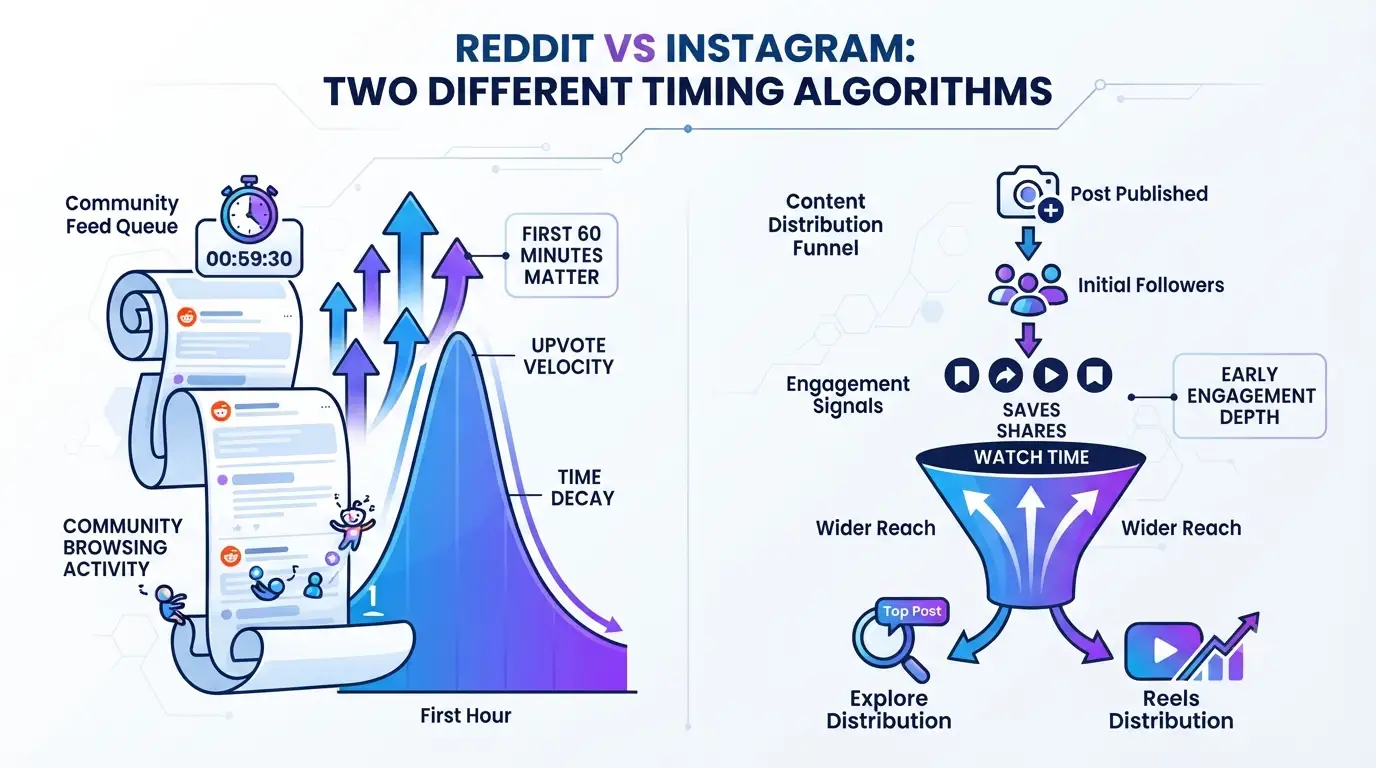
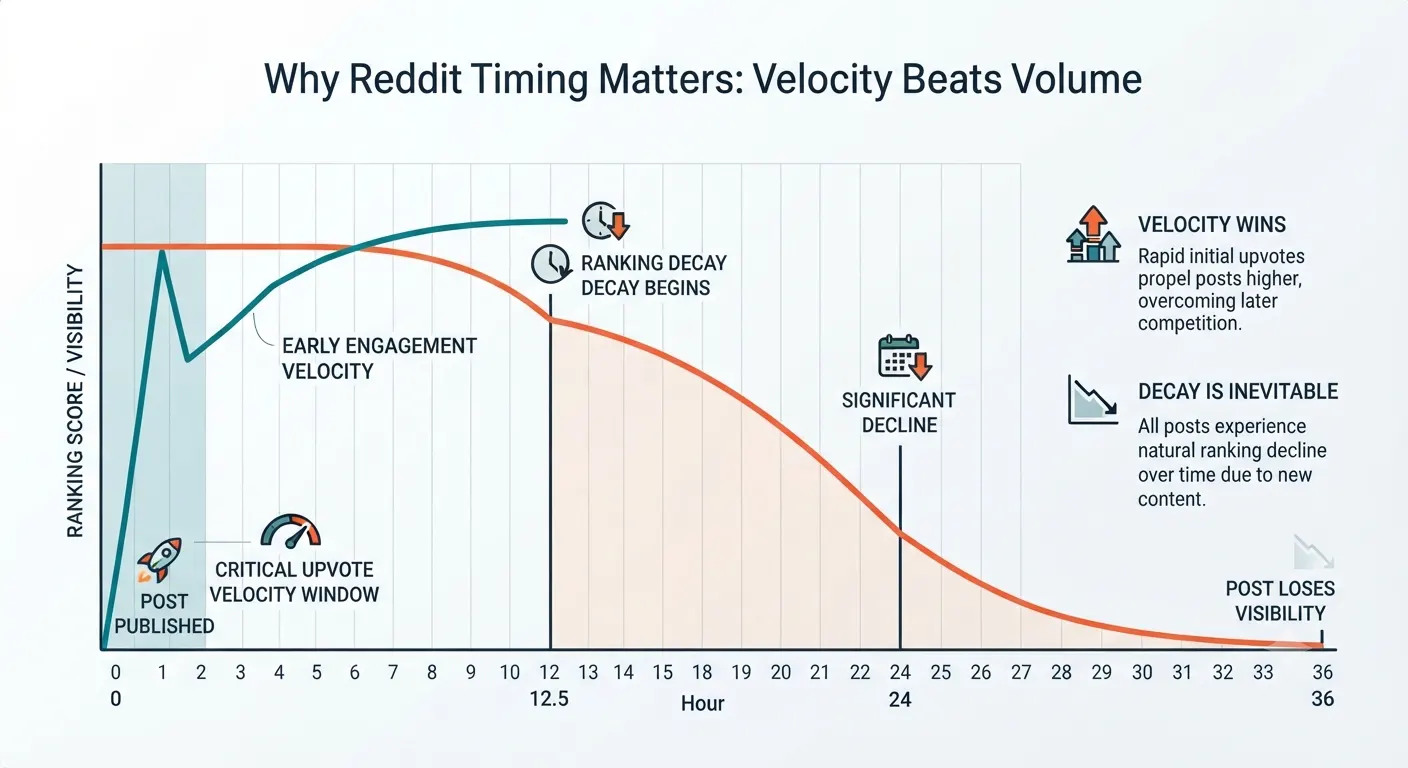
Reddit runs an open queue with time-based decay. Every post starts at position zero in a subreddit's "new" tab and has to earn its way up with no follower buffer to catch it. Reddit's hot-ranking algorithm scores posts logarithmically — the first 10 upvotes carry as much ranking weight as the next 100 — and actively penalizes age, dropping a post's rank every ~12.5 hours regardless of score. A post earning 15 upvotes in its first 30 minutes will outrank one earning 100 upvotes over 12 hours. You are racing the clock from the moment you hit publish.
Instagram runs a staged distribution cascade. When you post, Instagram tests your content with a limited initial group of followers, measures how quickly they respond, and uses those early signals to decide whether to expand reach further — first to a wider follower group, then potentially to non-followers through Explore and Reels. Strong early signals push distribution forward; weak signals stall the post before most of your audience ever sees it. You're not competing against an open public queue; you're passing a private audition in front of your own followers. (Instagram has not officially published the exact initial distribution parameters; the staged model is based on public statements from Instagram head Adam Mosseri and third-party analysis by Buffer and Later.)
The practical implication: on Reddit, you need upvote velocity from strangers who are actively browsing a community when you post. On Instagram, you need engagement depth from followers who are online and in the right mindset to interact when you post. Two different problems, two different optimization strategies — and a cross-platform schedule that ignores this distinction will consistently underperform on at least one of them.
2. Best Time to Post on Reddit — The Algorithm Logic Behind It
Reddit's hot-ranking algorithm has been open-source for years. Its mechanics explain exactly why the first hour matters more on Reddit than on virtually any other platform.
Upvotes are weighted logarithmically, not linearly. A post's score is based on the log₁₀ of its net vote count. In practice: the jump from 1 to 10 upvotes moves the needle as much as the jump from 10 to 100. Those first ten votes are your highest-leverage moment. If they don't arrive quickly, your post's trajectory is essentially set.
Age is a dominant penalty, not a neutral factor. Time decay is built directly into the ranking formula. Every 12.5 hours that pass, a brand-new post earns the equivalent of roughly 10 net upvotes just by being younger than yours. After 24 hours, you'd need about 100× more upvotes to hold the same position you held at hour one. After 36 hours, most posts are effectively dead in the algorithm's eyes.
Together, these two rules make upvote velocity in the first 60 minutes the most decisive ranking signal on Reddit. Posting when your target community is actively browsing is how you earn those critical early votes before time-decay math runs out the clock.
What the data shows about scale: a 2026 analysis by Upvote.net examined 1,000 posts that reached Reddit's front page, converting each timestamp to US Eastern time (about 57% of Reddit's user base is US-based). The results by posting window:
Time window (US Eastern) | Median upvotes |
|---|---|
5–8 AM | 13,482 |
9 AM–12 PM | 6,479 |
1–4 PM | 2,966 |
5–8 PM | 1,414 |
9 PM–12 AM | 783 |
12–4 AM | 512 |
The morning window produced roughly 8× the median upvotes of the late-night dead zone — a gap explained entirely by velocity, not content quality. Morning posts accumulated votes through the full US workday; late-night posts racked up time-decay penalties while America slept and were buried by morning.
The often-overlooked factor: subreddit size. That same study found that subreddit subscriber count was actually a stronger predictor of total upvotes than posting time. Posts in communities with 10M+ subscribers earned roughly 6× the median of sub-500K communities. The lesson isn't "only post to giant subreddits" — niche communities convert far better for actual marketing goals — but it does mean that which subreddit you pick is a bigger lever than when you post. Get both right.
2b. Comparing the Reddit Evidence: Where Studies Agree — and Why One Doesn't
Most "best time to post on Reddit" guides pick one dataset and present it as fact. The problem is that the five most-cited timing analyses reach different conclusions. These differences aren't random errors; they reflect genuine methodological differences that tell you something precise about which numbers actually apply to your situation.
How the major Reddit timing studies compare
Study | Sample basis | Primary methodology | Peak finding | Key limitation |
|---|---|---|---|---|
Upvote.net (2026) | 1,000 posts that reached Reddit's front page (r/all) | Timestamps converted to US Eastern; sorted by median upvotes per window | 5–8 AM ET strongest; 9 AM–12 PM second | Sample is inherently skewed toward Reddit's largest, most-subscribed communities |
PostWatch | Subreddit-level aggregate (sample size not published) | Pulls historical timing data from individual community post histories | Weekday mornings (Tue–Thu, 6–10 AM) for professional subreddits | Methodology not fully disclosed; limited to communities in its index |
Postpone | Aggregate from tens of thousands of posts submitted via their scheduling tool | User-submitted posts, platform-wide mix | Sunday, Saturday, and Wednesday 11 PM–1 AM as peak windows | User base likely skews toward entertainment and casual content; professional subreddits are under-represented |
RedShip | Aggregate from subreddit-specific post histories | Post history analysis per subreddit | Weekday morning consensus, aligned with PostWatch | Specific sample size and methodology not publicly documented |
Leadmore AI (June 2026) | Synthesis of PostWatch, Postpone, RedShip, and Postiz data | Cross-referenced multiple datasets; reconciled by subreddit category | Varies by category — mornings for professional, evenings for entertainment | Synthesis, not primary research; inherits limitations of source datasets |
Where the studies agree: the consensus zone
Across all five sources, three findings are consistent enough to treat as settled:
Tuesday through Thursday is the highest-engagement window for professional and business subreddits. Every dataset that segments by community type — rather than reporting a platform-wide average — points to this three-day window. r/Entrepreneur, r/SaaS, r/marketing, r/programming, and similar communities consistently peak here.
Midnight to 5 AM ET is the dead zone for US-focused communities. No study reports meaningful engagement in this window for any professional or general-interest subreddit. The time-decay math makes this intuitive: a post submitted at 2 AM has already lost most of its ranking potential before the US audience wakes up.
First-hour upvote velocity is the mechanism that makes timing matter. This isn't disputed by any source — it follows directly from Reddit's open-source ranking algorithm. All timing advice is ultimately downstream of this principle: post when your community is awake, because those first votes determine whether the algorithm does the rest of the work for you.
Where the studies disagree: the conflict zone
The most striking split is this: PostWatch, RedShip, and the Upvote.net front-page analysis converge on weekday mornings as the dominant peak. Postpone reports the opposite — weekend evenings, specifically Sunday, Saturday, and Wednesday, 11 PM–1 AM, as the strongest windows.
That's a gap of more than 12 hours between what two credible sources consider peak posting time. If you try to apply both at once, you'd post around the clock and learn nothing.
Why the disagreement exists — and what it actually reveals
This conflict is not a case of one study being right and the others being wrong. It's a case of each study measuring a genuinely different slice of Reddit.
Reddit's platform-wide activity is dominated by its largest communities. The top 10 subreddits by subscriber count are almost entirely entertainment and casual content: r/funny (50M+), r/gaming (38M+), r/aww (35M+), r/todayilearned (36M+), r/memes (25M+). These communities have globally distributed audiences who are most active in the evenings and on weekends — when people are home, unwinding, and in passive consumption mode.
When you aggregate all of Reddit's timing data without filtering by community type, these massive entertainment subreddits dominate the sample and pull the "overall best time" toward weekend evenings. Postpone's aggregate likely reflects this broader platform mix, because a general scheduling tool attracts a diverse user base, many of whom post to entertainment communities.
The Upvote.net study, PostWatch, and the morning consensus sources reflect a different signal: either they specifically filter for professional and business community types, or they show community-specific data that the r/funny effect doesn't distort.
The practical implication from this analysis: if your goal is to reach r/Entrepreneur, r/SaaS, r/marketing, r/technology, or similar professional communities, the weekday morning consensus (Tuesday–Thursday, 6–9 AM ET) is the more applicable finding for your use case. If you're posting to r/gaming, r/movies, r/memes, or large entertainment communities, Postpone's evening and weekend finding is more relevant. The studies aren't in conflict — they're measuring different Reddits.
This is the core reason why the category-specific table in Section 3 is more useful than any platform-wide best-time average: the right answer depends entirely on which Reddit you're actually posting to.
3. Best Time to Post on Reddit by Day and Subreddit Category
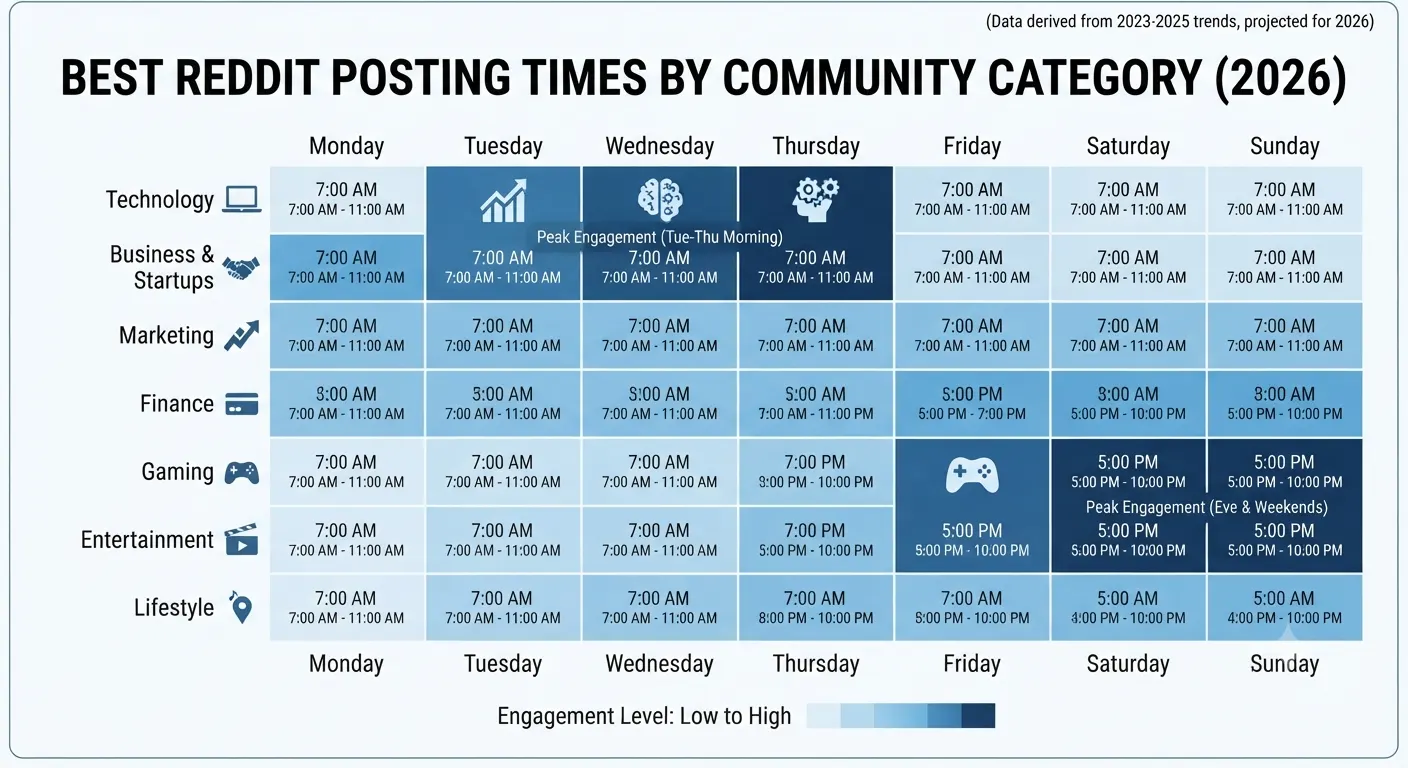
The general consensus (US Eastern time): Tuesday through Thursday, 6–9 AM is the highest-engagement window for most subreddits — particularly professional, tech, business, marketing, and finance communities. An evening window (6–9 PM) provides a secondary peak for news and discussion communities. Weekends are largely dead for business-focused subreddits but alive for gaming, entertainment, and hobby communities.
Day-by-day breakdown:
Monday: A slow restart after the weekend. The best window is 9 AM–12 PM; avoid early morning. Not the day for your most important posts.
Tuesday–Thursday: The power window for most subreddits. Strong engagement from 6 AM through late morning, with the clearest peak around 7–9 AM. If you're posting once a week, Wednesday morning is statistically the strongest single slot across tech, business, and general communities.
Friday: Morning still works (7–10 AM), but attention fades after noon. Save high-value posts for earlier in the week.
Saturday: Weak for professional and B2B communities; strong for gaming, entertainment, and lifestyle subreddits — especially evenings and late morning.
Sunday: Similar to Saturday for consumer content, with a notable Sunday-evening bump in finance, self-improvement, and planning communities.
Where the general advice breaks down: subreddit-specific timing. Applying one schedule to every subreddit is the single most common Reddit timing mistake. A gaming community peaks Saturday evening; a B2B startup community peaks Tuesday morning. Treating them the same wastes your best content.
Best posting times for each subreddit category:
Category | Example subreddits | Peak window (US Eastern) |
|---|---|---|
Tech & Programming | r/programming, r/webdev, r/technology | Tue–Thu, 6–10 AM |
Business & Startups | r/Entrepreneur, r/startups, r/SaaS | Tue–Thu, 7–11 AM |
Marketing & SEO | r/marketing, r/digital_marketing, r/SEO | Tue–Thu, 9–11 AM & 1–3 PM |
Finance & Investing | r/personalfinance, r/investing, r/stocks | Weekdays 7 AM–12 PM; Sun evening |
Crypto & Web3 | r/CryptoCurrency, r/ethfinance | Nearly 24/7; US evenings & weekends |
Gaming | r/gaming, r/pcgaming, r/gamedev | Evenings 6–11 PM; all weekend |
News & Politics | r/worldnews, r/news, r/politics | Daily, 6–9 AM & 5–8 PM |
Health & Fitness | r/fitness, r/loseit, r/nutrition | 5–8 AM; weekend mornings |
Science & Education | r/science, r/askscience | Weekdays, 9 AM–1 PM |
Entertainment | r/movies, r/television, r/Music | Evenings & weekends, 5–11 PM |
Lifestyle & Hobbies | r/photography, r/travel, r/cooking | Evenings & weekend mornings |
One more piece of data worth flagging: a controlled Q4 2025 test posted 150 comparable pieces across three subreddits (r/Entrepreneur, r/productivity, r/LifeProTips) at different times — same formats and title quality, only the hour varying. Tuesday and Wednesday mornings beat Monday mornings by roughly 40% in median upvotes after 24 hours. Day of week matters as much as time of day, and most timing advice conflates the two.
4. Tools to Find the Best Posting Times for Each Subreddit
The best approach is to combine a benchmark tool with manual subreddit-level analysis. Here's what to use:
Postpone and PostWatch are purpose-built Reddit analytics tools that pull historical performance data from subreddits you specify. Postpone's aggregate analysis consistently shows that late-night weekend windows outperform weekday mornings for entertainment-heavy communities — a concrete illustration that no universal timing chart is accurate across all content types. PostWatch provides a similar subreddit-specific view with a slightly different interface. Either is a good starting point if you want to find the best time to post on Reddit based on your specific community's actual post history, rather than category averages.
Leadmore AI takes a different approach: this free Reddit timing tool synthesizes timing data across categories and presents it as an interactive heatmap filterable by subreddit type and time zone, making it easier to get a quick benchmark without manually auditing multiple subreddits. A free 90-day Reddit posting calendar (PDF, no email required) is also available. Beyond timing, Leadmore AI's core product covers Reddit marketing more broadly — subreddit discovery, lead tracking, and content publishing through established accounts.
The manual method (free, most accurate for your specific subreddit): Sort your target subreddit by "Top → This Week" and check the timestamp on the posts with the highest early-hour engagement. Do this over two to three weeks and you'll have a reliable peak window. Takes about 15 minutes per subreddit and is more accurate than any external tool, because it's about that community's actual behavior — not a category average.
The contrarian play that often works: Because so many marketers follow the conventional wisdom and post at the peak hour, those minutes get crowded. Publishing 30 minutes before your target window — so your post is already accumulating early votes when the audience arrives — tends to outperform posting at the exact peak.
5. Best Time to Post on Instagram — The 30-Minute Distribution Window
Instagram's 2026 algorithm no longer distributes content primarily through a chronological follower feed. Posts go through a staged audition: Instagram shows your content to an initial group of followers and measures how quickly they engage — the signals it weights most heavily are "sends per reach" (how often people DM your post to a friend), saves, and watch time. Likes register as the weakest signal in this hierarchy. This weighting shift has been described publicly by Instagram head Adam Mosseri and is consistent with how Buffer, Later, and Sprout Social have documented the platform's engagement patterns through 2025–2026.
The first 30–60 minutes is the highest-leverage window. Strong velocity in that period significantly increases the likelihood of expanded distribution — to a wider follower group, and eventually to non-followers through Explore and Reels feeds. Weak early signals make a stall more likely, though Instagram's algorithm isn't strictly binary: some posts do gain traction after the initial window, particularly Reels that get shared externally. The general pattern holds: early engagement is your best signal amplifier.
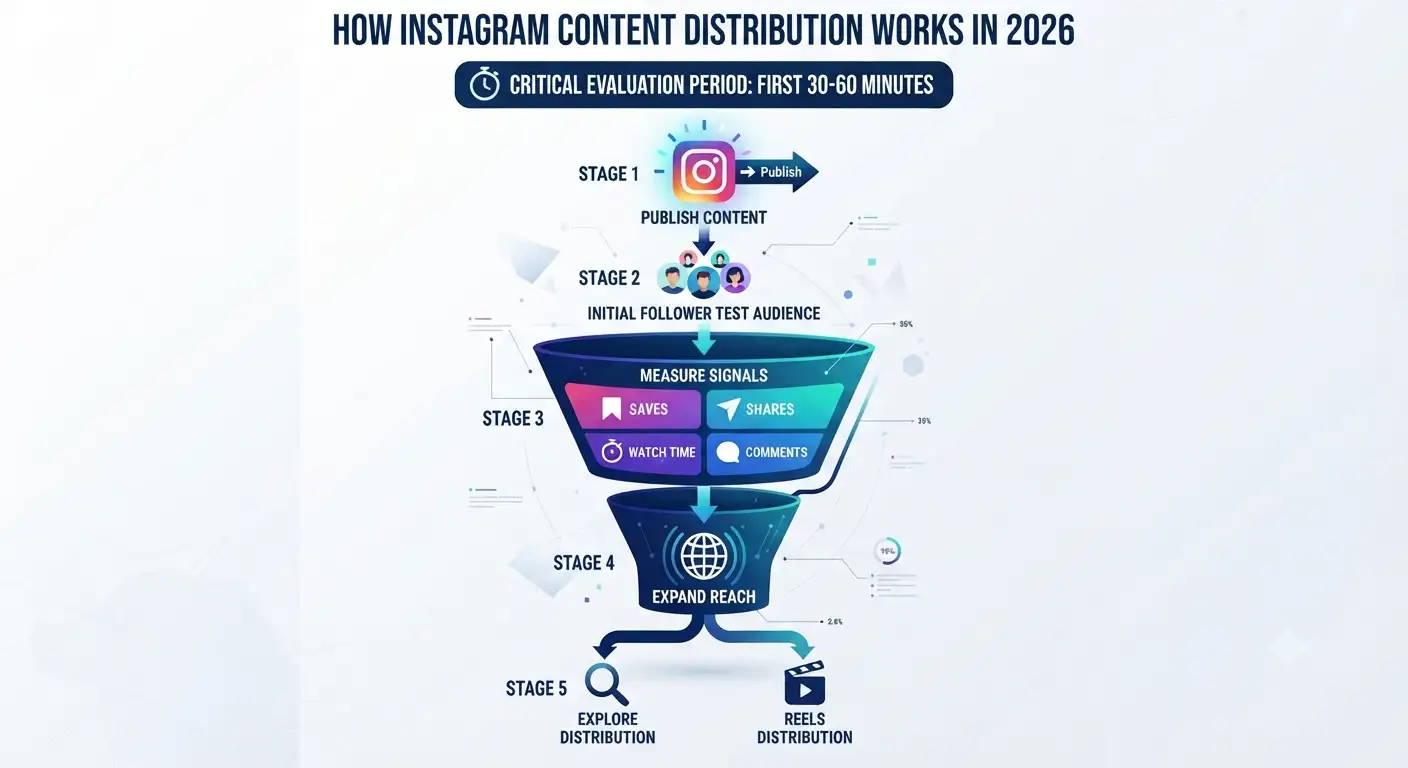
Timing's real job on Instagram is this: publish when your followers are already awake, scrolling, and in the right mindset to engage deeply (saving, sharing, finishing the video) — not just passively scrolling past. Those two conditions don't always coincide at the same hour, and which content format you're posting changes the calculus.
What the major 2026 datasets agree and disagree on:
The most credible studies diverge on exact hours because each reflects a different slice of accounts:
Buffer's analysis of 9.6 million posts (the largest single-source study in 2026): top individual slots are Thursday 9 AM, Wednesday 12 PM, and Wednesday 6 PM. Evening hours outperform mornings on most days, with the Thursday morning as the notable exception.
Later's analysis of 6 million+ posts: the strongest overall signal is 5 AM in the audience's local time zone — explained by low competition and catching the first-scroll-of-the-day window.
Sprout Social (30,000+ customers, Nov 2025–Feb 2026): best times are Tuesday 1–7 PM, Wednesday 12–9 PM, and Monday 2–4 PM.
Hootsuite's 2025 analysis: Instagram engagement peaks during early mornings and early evenings, especially early in the week.
How the major Instagram timing studies compare
Rather than picking one study and presenting it as universal truth, here's how the five most-cited 2025–2026 analyses compare side by side — including what each one measured, what it found, and where its limitations are.
Study | Sample | Measurement period | Primary methodology | Single best slot | Best days |
|---|---|---|---|---|---|
Buffer (2026) | 9.6M posts, 200,000+ accounts | Jan 2024–Dec 2025 | Median engagement rates (not averages, to prevent skew from large accounts) | Thursday 9 AM | Wednesday, Thursday |
Later (Apr 2026) | 6M+ posts including Reels | Jan–Oct 2024 | Engagement rate by hour across all time zones | 5 AM (all days) | No strong day-of-week pattern; 3–6 AM daily window leads |
Sprout Social (2026) | 30,000+ customers globally | Nov 2025–Feb 2026 | Engagement data from Sprout's publishing platform; enterprise-weighted | Tuesday 1–7 PM | Monday, Tuesday, Wednesday |
Hootsuite (2025) | Not specified | 2025 annual analysis | Perch tool data aggregation | Early morning & early evening | Monday, Tuesday, Thursday |
Hopper HQ (2026) | Not specified | 2026 | Platform-level analysis | Wednesday 11 AM | Wednesday |
The spread in "best single slot" ranges from 5 AM (Later) to mid-afternoon (Sprout Social) — a potential gap of eight or more hours depending on which study you follow.
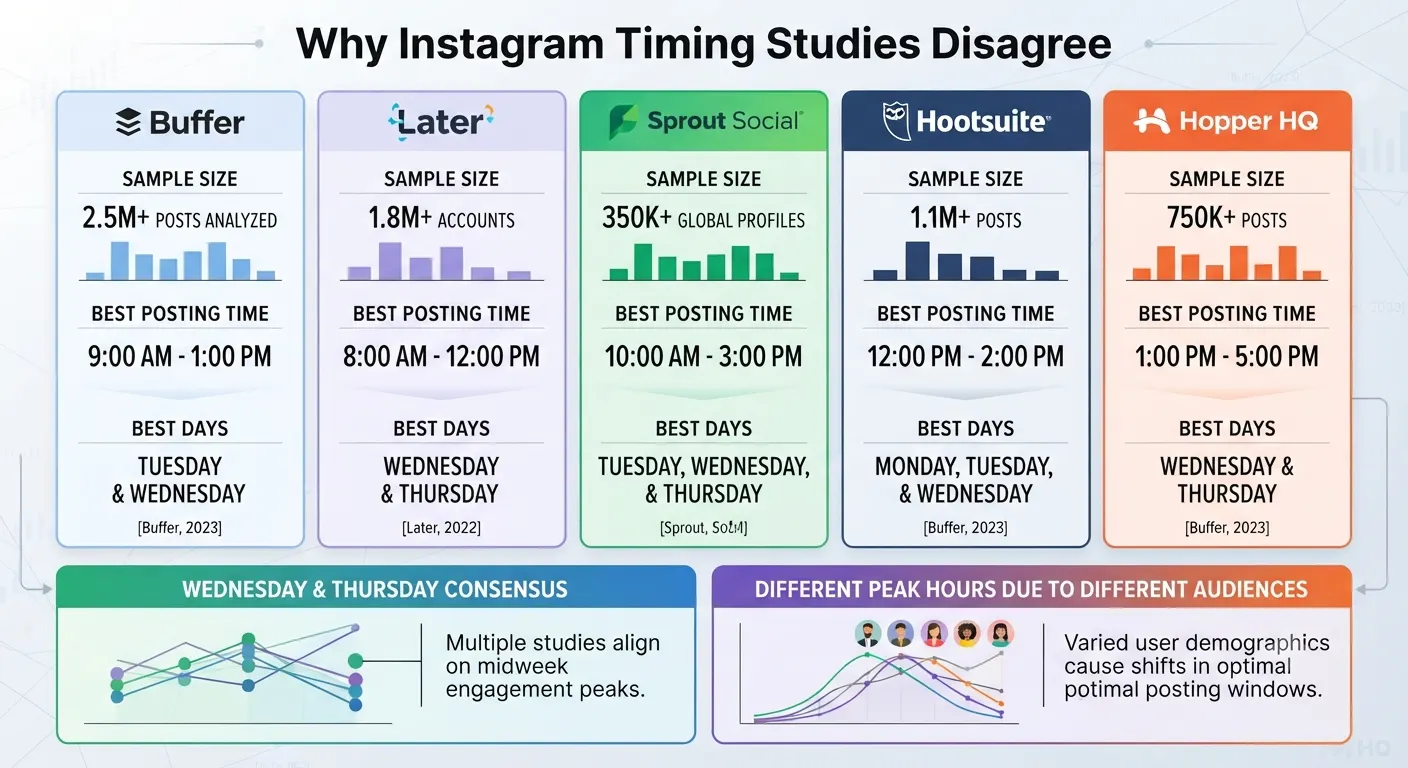
Where the Instagram studies agree: the consensus zone
Despite the variance in exact hours, five findings are consistent across all or nearly all of the studies:
Wednesday is the best day to post on Instagram. It appears as a top-three day in every study that reports day-level data. If you're running a single post per week and want to give it the best structural conditions, Wednesday is the least-contested answer the data produces.
Tuesday through Thursday collectively outperform the rest of the week. This three-day window appears across all five datasets. It's not about any single hour — it's about a midweek engagement pattern that reflects real user behavior (people are active and in a focused mindset; the weekend distraction hasn't kicked in yet).
Friday and Saturday are the weakest days for high-value content. Every major study places Friday and Saturday at or near the bottom for feed post engagement. Both Sprout Social and Buffer explicitly flag these days as the lowest-performing across their datasets.
Early engagement velocity matters for reach. All five studies — in different ways — confirm that Instagram's current distribution model rewards early interaction. Whether you frame it as "the first 30 minutes" or "the seed audience signal," the practical implication is the same: posting into an empty time window wastes your best content.
Where the Instagram studies disagree: the conflict zone
The meaningful divergences fall into two categories:
Best single time slot: Buffer says Thursday 9 AM; Later says 5 AM every day; Sprout Social says Tuesday afternoon. The spread is not just noise — it reflects real differences in the audiences these tools are measuring.
Whether mornings or evenings dominate the daily peak: Buffer finds that evening hours outperform mornings on most days of the week, with Thursday morning as the one exception. Hootsuite and Later both highlight early-morning windows as competitive. Sprout Social's enterprise data skews toward afternoon.
Why the Instagram studies disagree — and what it reveals
Three structural factors explain most of the divergence:
Account-size composition is the biggest driver. Later's 6M-post sample includes a large proportion of smaller accounts with highly engaged, niche followings. These accounts tend to perform best early in the morning — not because their audiences are most active at 5 AM, but because the competition from other accounts is lowest. A smaller account posting at 5 AM faces less noise and captures a higher share of its followers' first-scroll attention. Sprout Social's enterprise customers manage large brand accounts with broad, less-niche audiences, where afternoon windows — when more people are actively online — produce better absolute results. Buffer's median-based methodology sits between these two extremes and produces a Thursday morning peak that reflects the midpoint.
Measurement metric differs across studies. Buffer explicitly uses median engagement rates to avoid inflating results with viral outlier posts. Studies using average engagement rates are susceptible to a small number of high-performing posts distorting the hourly data. A post going viral on a Wednesday night can make "Wednesday night" look like the best time even if the typical Wednesday-night post performs poorly.
Later's 5 AM finding requires a specific interpretation. It doesn't mean Instagram audiences are most active at 5 AM — they're not. It means that posting at 5 AM produces a favorable signal-to-noise ratio: lower competition, first-morning-scroll capture, and the accumulated engagement of the early hours building momentum before the rest of the day's posts arrive. It's a competitive positioning play, not an audience activity claim. Worth testing, particularly for accounts with a global audience spread across time zones.
The practical synthesis: Wednesday and Thursday are the best days to post on Instagram across all credible 2026 datasets. For the specific hour within those days, check your own Instagram Insights first — because the studies are measuring different types of accounts, and your account's audience has its own rhythm that no external benchmark can substitute.
6. Best Time to Post on Instagram by Day, Format, and Industry
By day:
Monday: A recovery day. Best windows are 2–4 PM and around 7 PM as people settle into their feeds after the weekend.
Tuesday: One of the strongest days overall. Engagement holds across a wide afternoon-to-evening band (1–7 PM), peaking near 7 PM.
Wednesday: The single best day to post on Instagram based on the broadest dataset consensus. Clear peaks at 12 PM (lunch) and 6 PM (after work), with strong engagement through 9 PM.
Thursday: Nearly tied with Wednesday, with a distinctive early-morning peak at 7–9 AM — the one prominent exception to Instagram's general evening skew.
Friday: Engagement drops as the weekend mentality kicks in. Late evening (~9 PM) is the least-bad option; save high-value posts for midweek.
Saturday: Consistently the weakest day. Use for lightweight Stories or community engagement, not major content launches.
Sunday: Slow through the day, recovering in the evening (5–9 PM) as people prep for the week ahead.
By content format:
Format changes the optimal hour because each format serves a different user mindset — a pattern Instagram head Adam Mosseri has described explicitly in public statements about how the app is used.
Carousels: Best posted mid-morning (8–11 AM) and around lunch (12–1 PM) on Tuesday or Wednesday. Carousels require swipe-through attention, and attention is higher earlier in the day. They also earn the most saves of any format — and saves are heavily weighted in Instagram's 2026 ranking. Buffer's data shows carousels averaging about 109% more engagement than Reels, making them the highest-ROI format for most accounts and the most time-sensitive to post correctly.
Reels: Best in the evening (6–11 PM), especially Wednesday and Thursday. Reels lean on algorithmic Explore distribution, making them somewhat less time-sensitive than carousels — but first-hour watch time and shares still determine whether the algorithm extends reach.
Stories: Evening (6–9 PM) for consumer brands; around lunch (11 AM–1 PM) for B2B. Stories last 24 hours and are less timing-sensitive than feed posts. The bigger lever here is frequency: 3–5 Stories per day keeps you visible without hurting feed reach.
Single images: Follow the overall heatmap most closely — lunch window (11 AM–1 PM) and early evening (6–8 PM). They trail carousels and Reels on engagement, so reserve them for moments where a single strong image is genuinely the right format.
By industry:
Industry | Peak window (local time) | Why |
|---|---|---|
Fitness & Wellness | 5–7 AM | Audiences are planning or finishing workouts at dawn |
Fashion & Beauty | 6–9 PM | After-work, leisure-browsing mood |
E-commerce & Retail | 11 AM–1 PM & 7–10 PM | Lunch browsing + evening shopping sessions |
Food & Beverage | 11 AM–1 PM & 5–7 PM | Mealtime hunger and dinner planning |
B2B, SaaS & Tech | 11 AM–3 PM (weekdays) | Professionals browse during structured workday breaks |
Travel & Hospitality | 5–7 PM | The "planning my next trip" evening mindset |
7. Tools to Check Your Optimal Posting Window on Instagram
Instagram Professional Dashboard (free — and the most accurate tool you have): Open the app → Professional Dashboard → Insights → Total Followers → Most Active Times. This shows your specific followers' active hours and days. No external tool can beat this for your account, because it's your actual audience's behavior — not an industry average. Check it weekly and build your schedule around it, using external benchmarks only to fill gaps when you have insufficient data.
Leadmore AI's Instagram scheduler offers a free interactive timing heatmap filterable by content type (Reels, carousels, Stories), industry, day, and time zone — with automatic conversion to your local time. The underlying data synthesizes Buffer's 9.6M-post study, Sprout Social, Later, and Hopper HQ. Free downloadable resources include a 90-day Instagram posting calendar and an Instagram Growth Playbook (PDF) — both available without an email sign-up. Useful as a starting benchmark before your own Insights data becomes statistically reliable, and for cross-referencing industry-specific windows.
Later provides account-level "Best Time to Post" recommendations based on your own follower engagement data, backed by their 6M+ post analysis. Strong choice if you're already using Later for content scheduling.
Hootsuite (Perch) and Sprout Social both offer personalized optimal-time recommendations within their scheduling platforms, powered by their respective large customer datasets. Both are paid tools aimed at teams managing multiple accounts.
The contrarian morning window: Later's data points to a 5 AM "first scroll of the day" slot with lower competition and higher-than-average engagement rates. Worth A/B testing — particularly for accounts with audiences spread across multiple time zones — rather than treating as a universal recommendation.
8. Cross-Platform Timing: Building a Schedule That Works on Both
Here's the tension most cross-platform timing guides ignore: the best time to post on Reddit for a B2B or tech audience (Tuesday–Thursday, 6–9 AM ET) and the best time to post on Instagram for a similar B2B or SaaS audience (Tuesday–Thursday, 11 AM–3 PM) don't overlap. If you're actively managing both platforms, you can't post at the same time and expect peak performance on either.
A practical daily framework built around this difference:
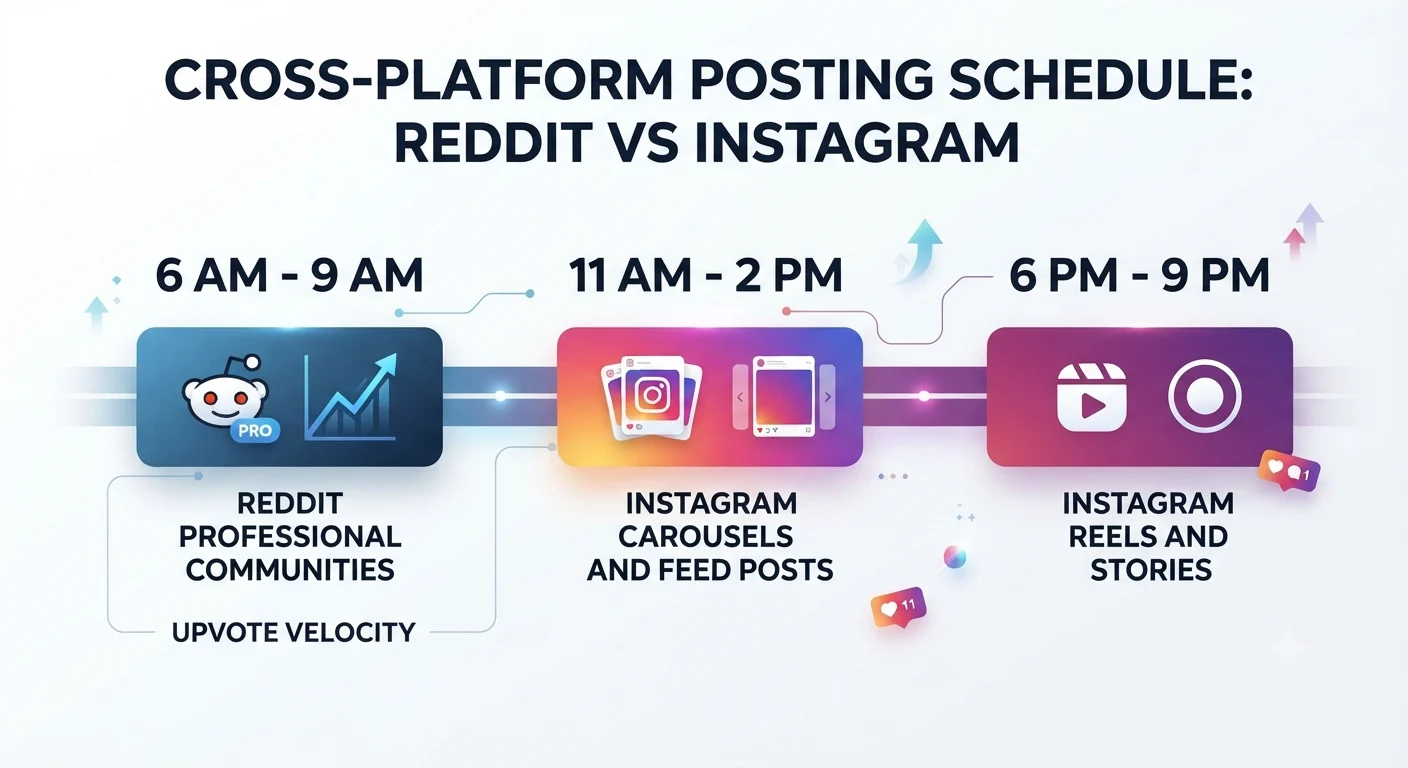
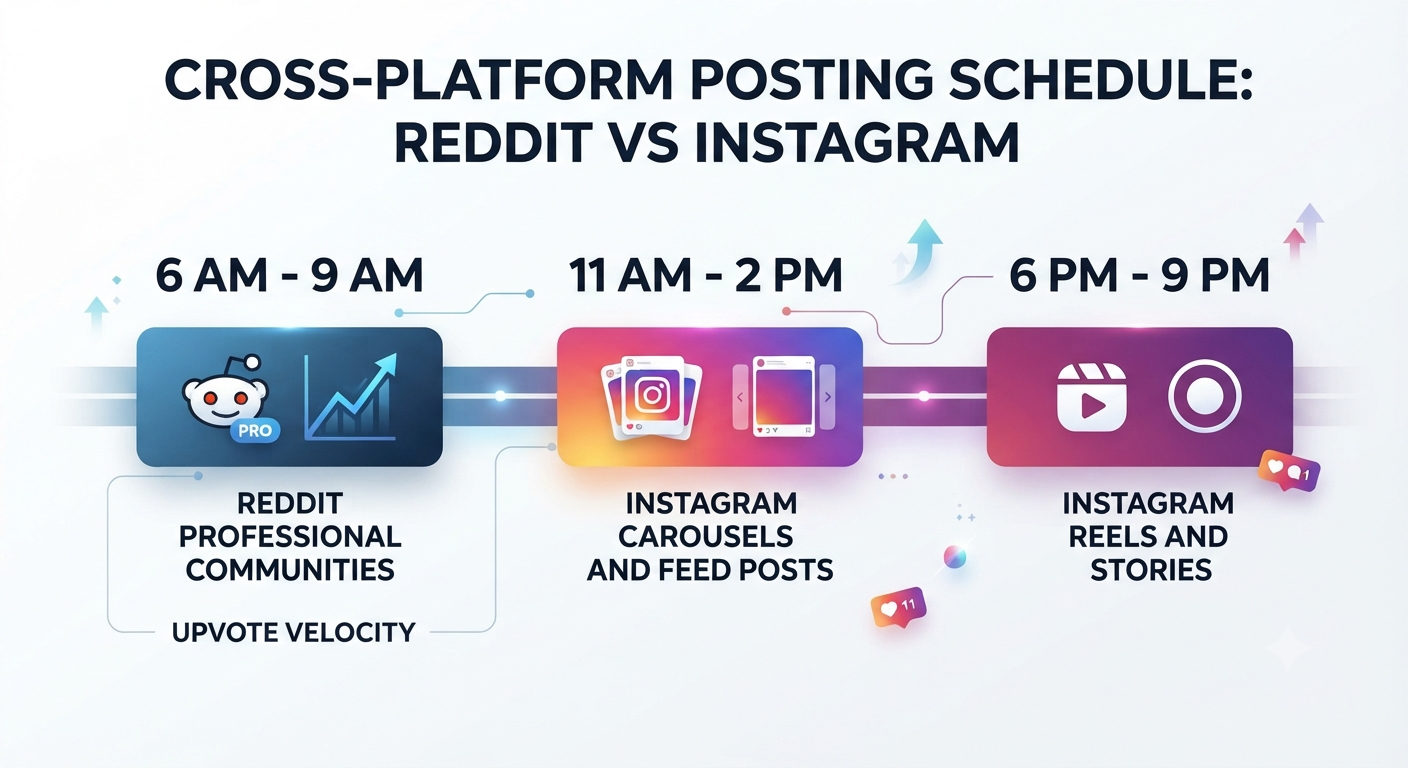
Morning block (6–9 AM ET): Reddit only. This is when the time-decay math most favors early upvote velocity for professional and tech subreddits. Be online for the first 30–60 minutes to respond to early comments — replies compound momentum by signaling discussion activity to the ranking algorithm.
Midday block (11 AM–2 PM ET): Instagram carousels and feed posts. This is when Instagram audiences tend to have structured focus — lunch breaks, mid-morning routines — and carousels specifically require active engagement rather than passive scrolling. Wednesday and Thursday are the strongest days in this slot.
Evening block (6–9 PM ET): Instagram Reels and Stories. People watch Reels to unwind, and this window also works for a second Reddit post if your target community is in gaming, entertainment, or lifestyle.
The underlying principle: separate your two platforms by format, intent, and audience mindset. Reddit requires a community-first, velocity-focused approach where you're participating in a public conversation. Instagram requires an audience-first, engagement-depth approach where you're publishing to a known group and trying to earn their deepest interactions. A unified content calendar that acknowledges this difference will consistently outperform one that treats both as "social media posts."
9. How to Find YOUR Specific Optimal Windows
Every benchmark in this guide — including data from Buffer, Later, Sprout Social, and Leadmore AI — represents an average across large, diverse sets of accounts. Your account has its own audience, its own niche, and its own behavioral rhythm. Use the benchmarks as a starting hypothesis, not an answer.

For Reddit — a simple test loop:
Start with the timing window that matches your subreddit's category from the table above.
Post consistently for 2–4 weeks at 2–3 candidate times, varying only the hour (same format and title quality throughout).
Track upvotes and comments in the first 60 minutes — not the 24-hour total. Velocity is what the algorithm actually rewards.
Double down on the winning window, then test it against a fresh challenger the following month.
Additionally, look at the manual method: sort your target subreddit by "Top → This Week" and note when the best-performing posts were published. The community's own history is the most accurate timing guide you can find.
For Instagram — the data lives in your account:
Open Instagram Insights → Most Active Times before you set any schedule.
Cross-reference your followers' active hours with the benchmark window for your content format (carousels → morning; Reels → evening).
Post in the overlapping window. Track saves and DMs, not just likes — those are the signals that drive distribution in 2026.
Re-check your Insights monthly; audience activity patterns drift seasonally, especially around major holidays and school calendars.
What "optimal" actually means: The goal isn't to post at the theoretically best minute. It's to consistently post at a time when your specific audience is online and in the right frame of mind, at a cadence you can sustain without sacrificing content quality. A schedule you maintain for six months beats a theoretically perfect schedule you abandon after three weeks.
Quick Reference Cheat Sheet
Algorithm core mechanic | Logarithmic upvote decay + time penalty | Staged distribution cascade triggered by early engagement depth |
Most decisive signal | Upvote velocity in first 60 minutes | Saves + DMs per reach in first 30–60 minutes |
Best days overall | Tuesday–Thursday | Tuesday–Thursday |
Strongest single window | Wed 7–9 AM ET | Wed 12 PM or Thu 9 AM (local time) |
Worst time | Midnight–5 AM (US-focused subs) | Friday afternoon; Saturday daytime |
Key exception | Gaming/entertainment → evenings & weekends | Fitness → 5–7 AM; Fashion → 6–9 PM |
Best cross-format move | Post 30 min before peak to get ahead of the crowd | Post 30 min before peak for the same reason |
Free benchmark tool | Leadmore AI | Leadmore AI + Instagram Professional Dashboard |
Most accurate data source | Manual audit of your subreddit's top posts | Your Instagram Insights (Most Active Times) |
Biggest mistake | Using one schedule for every subreddit | Trusting a benchmark over your own Insights data |
How We Built These Recommendations
Transparency matters when you're asking someone to restructure their posting schedule around a set of numbers. Here's exactly how the tables and windows in this guide were built.
Reddit timing data: We cross-referenced four publicly available timing datasets — PostWatch, Postpone, RedShip, and Postiz — alongside Leadmore AI's synthesis of those sources (updated June 2026) and the Upvote.net 1,000-post front-page study. Where the sources agreed, we reported the consensus. The main split we encountered: most sources (PostWatch, RedShip, the general consensus) point to Tuesday–Thursday, 6–9 AM ET; Postpone's aggregate reports the opposite — Sunday, Saturday, and Wednesday, 11 PM–1 AM. This disagreement is explained by what each dataset measures: platform-wide averages are dominated by Reddit's giant entertainment and news subreddits, which pull peak hours toward weekend evenings. Marketers posting to professional or niche communities are in a different dataset. We resolved this by cutting the data by subreddit category rather than blending it.
Instagram timing data: The five datasets we referenced — Buffer (9.6M posts), Later (6M+ posts), Sprout Social (30,000+ accounts, Nov 2025–Feb 2026), Hootsuite (2025 analysis), and Hopper HQ — each reflect different slices of the Instagram account universe. Buffer's sample is the largest single source and skews toward a wide range of account sizes. Later's analysis covers a global audience mix. Sprout Social's data is weighted toward enterprise customers. Where they agreed (Wednesday and Thursday as top days; midweek afternoons and evenings for most niches), we reported consensus. Where they disagreed (exact peak hours), we preserved the range and flagged the conflict.
What this guide does not include: Original primary research — we did not conduct our own controlled posting experiments and have not claimed to. All numeric findings are sourced from the published studies cited in the Sources section. The category-specific subreddit tables and industry-specific Instagram windows represent our editorial synthesis of those external sources, not proprietary data.
Limitations to keep in mind: All timing benchmarks are averages across large and heterogeneous datasets. They will not precisely match the behavior of your specific subreddit or your specific Instagram audience. Use them as a starting hypothesis and replace them with your own data as quickly as you can generate it.
Frequently Asked Questions
Does the best time to post on Reddit change by subreddit?
Yes — often dramatically. A gaming subreddit peaks on Saturday evening; an entrepreneurship subreddit peaks on Tuesday morning. The category table in this guide is a starting benchmark; a manual audit of your specific subreddit's top weekly posts is more accurate. No external tool can fully substitute for watching the community's own activity patterns.
Why do different studies give different best times to post on Instagram?
Each study reflects a different sample of accounts. Later's 6M-post analysis skews toward mid-size accounts with a global audience mix. Buffer's 9.6M-post study covers a broader range of account sizes. Sprout Social's data comes primarily from enterprise customers. None of them is your account. Use them to build a hypothesis; use your own Insights to confirm or override it.
Which matters more on Reddit: timing or subreddit size?
According to the 1,000-post front-page study, subreddit size was the stronger predictor of raw upvote counts. But for marketing purposes — where conversion and community fit matter more than reach alone — a well-timed post in a smaller, high-intent niche subreddit often outperforms a mediocre post in a giant general one. Optimize for both: pick the largest community that genuinely fits your content, then post at its peak.
Is posting on Instagram over the weekend worth it?
For high-value content like product launches or important Reels, generally no. The engagement data across all major 2026 studies shows Friday and Saturday as the lowest-performing days for feed posts. Weekends are better used for lightweight Stories that maintain presence without risking your best content on a low-attention window. Sunday evenings are a partial exception — engagement recovers as people shift into week-prep mode.
What's the single most common timing mistake across both platforms?
Optimizing timing before optimizing content quality. Timing is a multiplier — it amplifies what's already working. On Reddit, posting at the right hour can't save a post that reads like self-promotion in a community that bans it. On Instagram, even a perfect posting window won't compensate for content that earns passive likes but no saves or shares. Get the content right first, then optimize the clock.
How do I build a cross-platform schedule if my Reddit and Instagram peak windows conflict?
Use the morning block (6–9 AM ET) for Reddit — specifically for professional, tech, and business subreddits where morning velocity matters most. Use the midday-to-evening window (11 AM onwards) for Instagram. The two platforms' peak demands don't overlap for most B2B and professional content, which actually makes cross-platform scheduling easier: they're solving different problems at different times of day.
Sources
All timing data in this guide comes from the following published studies. We recommend reading the primary sources directly, especially if your niche or audience differs significantly from the general population those studies measured.
Reddit:
Upvote.net: "Reddit Upvote Study — Front Page Analysis" (2026, 1,000 posts) — upvote.net/blog/reddit-upvote-study
Single Grain: "Best Times to Post on Reddit for Maximum Engagement" (February 2026) — singlegrain.com
PostWatch: Reddit timing tool and subreddit-level data — postwatch.app
Postpone: "Best Time to Post on Reddit" aggregate tool — postpone.app/tools/best-time-to-post/reddit
RedShip: Reddit timing tool — redship.io/free-tools/best-time-to-post-on-reddit
Leadmore AI: Reddit timing synthesis by subreddit category (June 2026) — leadmore.ai/best-time-to-post-on-reddit
Reddit hot-ranking algorithm: open-source formula (widely documented; see GitHub archives)
Instagram:
Buffer: "State of Social Engagement 2026 — Instagram" (9.6M posts, 200,000+ accounts) — buffer.com/resources/when-is-the-best-time-to-post-on-instagram
Later: "Best Time to Post on Instagram in 2026" (6M+ posts, April 2026) — later.com/blog/best-time-to-post-on-instagram
Sprout Social: "Best Times to Post on Instagram in 2026" (30,000+ customers, Nov 2025–Feb 2026) — sproutsocial.com/insights/best-times-to-post-on-instagram
Hootsuite: "The Best Time to Post on Instagram" (2025 analysis) — blog.hootsuite.com/best-time-to-post-on-instagram
Hopper HQ: "The Best Time to Post on Instagram 2026" — hopperhq.com/blog/best-time-to-post-on-instagram
Leadmore AI: Instagram timing synthesis (June 2026) — leadmore.ai/best-time-to-post-on-instagram
Instagram algorithm: public statements from Instagram head Adam Mosseri (multiple interviews, 2024–2026) and Buffer's algorithm analysis — buffer.com/resources/instagram-algorithms
About the Author
Maya Chen is a social growth strategist and content analytics researcher specializing in Reddit and Instagram algorithms. She studies audience behavior, content distribution, and publishing patterns to help marketers improve their social media growth strategies through data-driven insights.
Last updated: July 2026. Timing data reflects studies published through June 2026. Audience behavior on both platforms shifts over time; we recommend revisiting this guide — and your own analytics — at least quarterly.