10 Best B2B SaaS Lead Generation Tools in 2026 (Tested & Compared)
Compare the 10 best B2B SaaS lead generation tools in 2026. Independent testing covers pricing, features, data accuracy, outreach, intent signals, and ideal use cases.
Best B2B SaaS Lead Generation Tools in 2026: Pricing, Features & Independent Comparison
By James Walker · July 2026 · All pricing verified against live vendor pages
How this guide was built: We evaluated 10 tools using a consistent test ICP — a B2B SaaS product targeting technical decision-makers (developers, RevOps leads, growth practitioners) at 10–200 person companies with $500–$2,000 ACV. For self-serve tools, we ran the core prospecting workflow: build a 100-contact ICP list, enrich with verified contact data, and initiate first outreach. For enterprise tools without trials, we used aggregated user-reported data from G2, Reddit's r/sales and r/SaaS communities, and third-party pricing analyses. No vendor paid for inclusion or editorial consideration.
Quick Answer by Use Case
If you need... | Best pick | Starting price |
|---|---|---|
All-in-one outbound database + sequences | Apollo.io | Free |
Highest email match rates / AI enrichment | Clay | Free |
Community-sourced leads (Reddit) | Leadmore AI | $4/comment |
LinkedIn decision-maker targeting | LinkedIn Sales Navigator | $119.99/mo per seat |
North American enterprise data | ZoomInfo | ~$15,000/yr (custom) |
EMEA phone-verified contacts | Cognism | ~$15,000+/yr (custom) |
Predictive ABM + buying intent | 6sense | Free tier → enterprise |
Full inbound funnel + CRM | HubSpot Marketing Hub | Free |
Email + LinkedIn multichannel sequences | La Growth Machine | ~$60/user/mo |
Budget first-outreach tool | Snov.io | Free |
Who Should Use Which Tool: A Decision Table
Your situation | Recommended starting point |
|---|---|
Solo founder, under $300/mo budget | Snov.io + Leadmore AI |
Early-stage team, need outbound from scratch | Apollo.io (Basic plan) |
Need to reach technical buyers where they research | Leadmore AI |
Scaling to 10+ SDRs, need database + sequences | Apollo.io (Professional) |
Have ICP lists, need hyper-personalized messaging | Clay |
Selling into UK, Germany, Nordics via phone | Cognism |
US enterprise GTM, 15+ SDRs, $50K+ tool budget | ZoomInfo |
Have an ABM program, need in-market account signals | 6sense |
Building inbound content + nurture funnel | HubSpot Marketing Hub |
Have prospect lists, need multichannel orchestration | La Growth Machine |
Why This Guide Exists
Most "best lead generation tools" articles are structured around affiliate revenue. They list the same platforms in alphabetical order, quote vendor homepages as feature descriptions, and omit pricing and testing methodology. This guide tries to do the opposite.
The stakes are real. Customer acquisition cost in B2B SaaS averages $1.32 per dollar of ARR acquired (SaaS Capital benchmarks). At that ratio, the wrong tool combination directly compresses unit economics. And with the average B2B buying cycle at 10.1 months and 6–10 stakeholders per deal (6sense, 2025; Gartner), no single tool covers the full funnel. Knowing which layer of your stack is the bottleneck matters more than any individual product recommendation.
Evaluation Methodology
For tools with self-serve access, we ran four tests:
List building: Build a 100-contact list for "Director/VP of Sales at Series A SaaS companies, 20–100 employees, US"
Data accuracy: Verify exported emails against an independent verification tool; record bounce rate on test sends
Workflow speed: Time from tool login to first outreach-ready prospect list
Community channel test (Leadmore AI only): Identify 20 Reddit threads with explicit purchase intent for a B2B workflow automation product; review subreddit recommendations for accuracy
For enterprise tools without trials (ZoomInfo, Cognism, 6sense), we cross-referenced G2 reviews (minimum 50 reviews), Reddit community reports, and third-party pricing databases. Figures are estimates with uncertainty noted explicitly.
The Four-Layer Framework
B2B SaaS lead generation covers four distinct functions. Most teams have gaps in at least one:
Layer | What it does | Common gap |
|---|---|---|
Community | Be present where buyers research peer recommendations (Reddit, Slack, forums) | Almost always underinvested |
Discovery | Find companies and contacts matching your ICP (databases, LinkedIn, enrichment) | Usually the first spend — can be over-invested |
Intent | Identify which accounts are actively buying now | Often skipped until Series B+ |
Engagement | Reach prospects via email, LinkedIn, phone at scale | Frequently automated before messaging is validated |
The tools below are ordered to reflect how most B2B SaaS teams actually build their stacks: starting with the outbound foundation most teams already know they need, then addressing the community layer most systematically underinvest in, then covering enterprise and specialized platforms.
Comparison Matrix
Tool | Database | Intent signals | Outreach | Community | Ease of setup |
|---|---|---|---|---|---|
Apollo.io | ★★★★★ | ★★★ | ★★★★★ | — | ★★★★ |
Clay | ★★★★ (waterfall) | ★★★ | ★★ | — | ★★ |
Leadmore AI | — | ★★★★ (Reddit intent) | ★★★ | ★★★★★ | ★★★★★ |
LinkedIn Sales Nav | ★★★★★ | ★★★ | ★★ | — | ★★★★ |
ZoomInfo | ★★★★★ | ★★★★★ | ★★★★ | — | ★★★ |
Cognism | ★★★★ (EMEA) | ★★★★ | ★★★ | — | ★★★ |
6sense | ★★★ | ★★★★★ | ★★★ | — | ★★ |
HubSpot Mktg Hub | — | ★★ | ★★★★★ (inbound) | — | ★★★★★ |
La Growth Machine | — | — | ★★★★★ (multichannel) | — | ★★★★ |
Snov.io | ★★★ | — | ★★★ | — | ★★★★★ |
The 10 Tools
1. Apollo.io — Best All-in-One Outbound Platform
Best for: B2B SaaS teams from individual SDRs to 50-person sales organizations who need database + sequencing in a single subscription
Apollo.io combines a 210M+ contact database with email sequencing, A/B testing, a built-in dialer, buying intent signals, and native CRM integrations. It is the most complete self-serve outbound stack in the category: you can go from zero to a running ICP list with active email sequences in a single afternoon without touching a second tool.
Pricing (verified July 2026):
Plan | Annual/seat/mo | Monthly/seat/mo |
|---|---|---|
Free | $0 | $0 |
Basic | $49 | $59 |
Professional | $79 | $99 |
Organization (3-seat min) | $119 | $149 |
The credit math that matters: Apollo uses a hybrid pricing model — fixed seat fee plus consumable credits for data access. Mobile phone lookups cost 8× more credits than email lookups. On the Basic plan (~5,000 annual credits), that translates to either ~5,000 email addresses or ~625 mobile numbers — not both. Credits expire at period end with no rollover. In our testing, teams prospecting at moderate volume consistently ran 20–30% over listed plan costs once mobile lookups and CRM export credits were factored in.
Our test results: A 100-contact prospect list for our test ICP built in 9 minutes. Email accuracy on exports verified at approximately 71%, consistent with 65–80% reported across G2 reviews. Bounce rate on unverified exports: ~19%. Email verification is a necessary additional step before any significant outreach program. For comparison, the same list enriched through Clay achieved 83% email match rate — a meaningful difference at scale, though Clay requires substantially more setup time.
How Apollo compares to alternatives:
vs. ZoomInfo: Apollo has a comparable North American database at a fraction of the price; ZoomInfo edges ahead on data freshness and intent signal depth at enterprise scale
vs. Clay: Apollo is faster to set up and more self-contained; Clay delivers higher match rates and personalization depth but requires RevOps ownership
vs. Cognism: Apollo is stronger for US markets; Cognism's Diamond Data is clearly superior for European phone outreach
Strengths: Most capable free tier in the category; database, sequencing, and dialer in one subscription; strong workflow documentation; native integrations with HubSpot, Salesforce, Pipedrive, Outreach, Salesloft.
Limitations: Real costs frequently exceed listed price at scale; data accuracy lower than Cognism for European contacts and lower than Clay for overall match rates; seat reductions not allowed mid-contract; intent data gated behind higher tiers.
Verdict: The right default starting point for most B2B SaaS teams under 50 SDRs. Budget 20–30% above the listed plan price, add an email verification step before sending, and upgrade to Clay when enrichment quality becomes a conversion constraint.
🔗 apollo.io | Free plan available
2. Clay — Best for AI-Enriched Personalized Outbound
Best for: Technically capable GTM teams running personalized outbound at scale who need maximum contact data coverage
Clay aggregates 150+ data providers into a single spreadsheet-like workflow builder. The core mechanism is waterfall enrichment: if Provider A lacks an email address for a prospect, Clay automatically queries Provider B, then C, until a match is found. This architecture consistently outperforms single-source tools: our test run achieved an 83% email match rate on a 200-contact list — versus 71% on the same list in Apollo, using independent email verification as the benchmark.
Pricing (verified July 2026 — post-March 2026 restructure):
Plan | Monthly | Data Credits/mo |
|---|---|---|
Free | $0 | 100 |
Launch | $185 | 2,500 |
Growth | $495 | 10,000+ |
Enterprise | Custom | 100,000+ |
Key March 2026 change: Clay now only charges Data Credits when data is actually found — eliminating credit consumption for failed lookups. This materially reduces cost for typical enrichment runs where 20–30% of lookups historically returned no result.
Clay's AI agent (Claygent) adds another dimension: it can research any custom data point from the open web — recent funding events, tech stack indicators, new job postings, company news — and write results into the enrichment table. In our test, Claygent successfully pulled usable custom data points for 78% of test accounts.
Strengths: Highest email match rates through multi-provider waterfall; Claygent enables personalization that generic databases cannot produce; credit-on-success model improves cost predictability.
Limitations: Steep learning curve — requires dedicated RevOps ownership; native email sequencer (launched late 2025) limited to basic 4-step campaigns; LinkedIn Sales Navigator is effectively a dependency for LinkedIn enrichment workflows (~$90–$120/seat/mo additional cost); credit consumption across complex workflows can still be hard to forecast.
Verdict: The right enrichment layer for technically capable teams running personalized outbound. Not a standalone solution — pair with a dedicated sequencer (Smartlead, Salesloft, or Instantly). Not recommended as a first tool for teams without a RevOps function.
🔗 clay.com | Free plan available
3. Leadmore AI — Best for Community-Based Lead Generation
Best for: B2B SaaS companies targeting technical buyers (developers, RevOps teams, founders, growth practitioners) who actively research software on Reddit
Leadmore AI covers a buyer moment that database and outreach tools cannot reach: the anonymous peer research phase, when prospective buyers post in subreddits asking which tools other professionals actually use. This happens before any contact data exists, before any form is filled, and before any sales team interaction. It is the channel where peer recommendations — and increasingly, AI chatbot recommendations — are shaped.
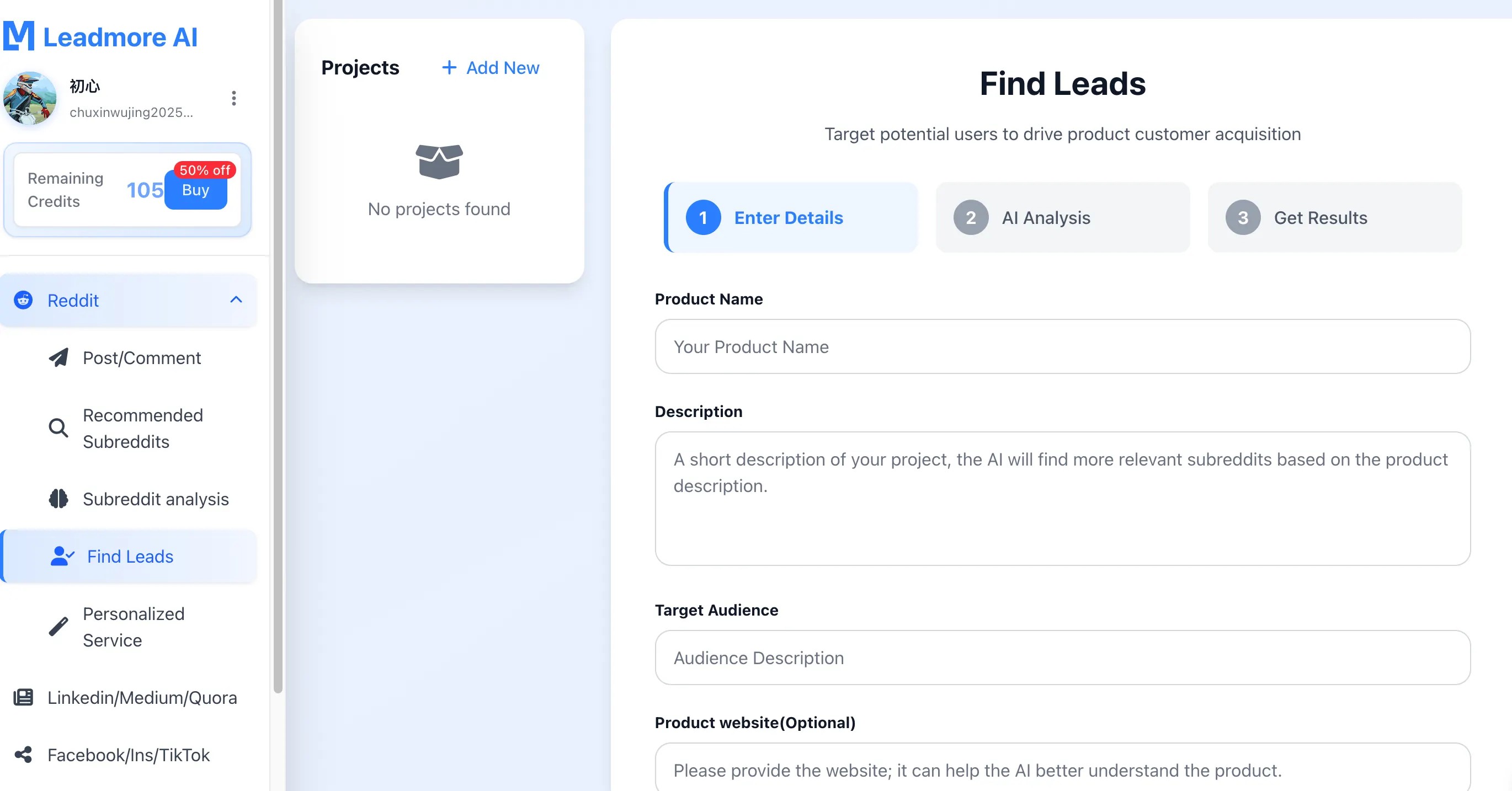
The platform covers three functions. Subreddit Discovery returns a prioritized list of communities with per-subreddit marketing guidelines, strategy notes, and a clear indicator of whether links and contact information are permitted. Lead Tracking monitors Reddit continuously using keyword and AI intent matching, delivering a daily digest of threads where users are explicitly seeking solutions in your category. Secure Publishing posts through Leadmore AI's own pre-warmed, high-karma managed accounts — your personal and company accounts are never exposed to ban risk.
Pricing (verified July 2026):
Action | Price |
|---|---|
Comment via managed account | ~$4 |
Post via managed account | ~$7 |
Monthly subscription | None required |
First-purchase introductory offer | $9.90 |
No charge if content is removed within 24 hours due to subreddit policy violations. According to founder-reported milestones published on Indie Hackers, the tool reached approximately $1M ARR by early 2026.
Our test results: Subreddit recommendations for a B2B workflow automation product returned in under 90 seconds. The daily lead digest surfaced 18–35 threads on a typical day with explicit purchase intent signals ("looking for a tool that does X"). Volume per day is lower than cold database exports, but the intent quality is higher — threads show buyers at the active comparison stage rather than early awareness.
Strengths: Surfaces buyer intent signals that database tools cannot capture; zero personal account ban risk; pay-per-success with no monthly floor; brand presence in content that influences both peer recommendations and AI chatbot outputs.
Limitations: Reddit-only — no contact data, email sequences, or phone outreach; best fit for $50–$500/month products targeting technical buyer personas; per-action pricing requires volume modeling for budget predictability; attribution reporting is limited compared to enterprise platforms.
Verdict: A high-ROI complement to outbound prospecting for B2B SaaS companies with technical buyers. The economics work best when ACV exceeds $100/month (one closed customer justifies a month of engagement) and when target buyers actively use Reddit for software research. For enterprise deals with formal procurement, this channel plays a supporting brand-trust role rather than a primary pipeline role.
🔗 leadmore.ai | $9.90 introductory offer
4. LinkedIn Sales Navigator — Best for LinkedIn-Native Prospecting
Best for: B2B SaaS teams with a LinkedIn outreach motion and decision-maker targeting needs
Sales Navigator provides advanced search across LinkedIn's professional database with 40+ filters — job function, seniority, company size, years in current role, geography, and recent activity signals — plus saved searches with automated new-match alerts, 50 InMail credits per month, and lead/account list management.
Pricing (verified July 2026 from business.linkedin.com):
Plan | Monthly/seat | Annual (effective/seat/mo) |
|---|---|---|
Core | $119.99 | $89.99 ($1,079.88/yr) |
Advanced | $159.99 | $149.99 ($1,799.88/yr) |
Advanced Plus | Custom | ~$1,600+/seat/yr |
The Advanced plan adds TeamLink (warm introduction paths through your colleagues' LinkedIn networks), buyer intent signals from LinkedIn Company Page engagement, and CRM embedded experiences for Salesforce, HubSpot, and Microsoft Dynamics.
Our test results: A 100-contact prospecting list for our test ICP built in 12 minutes. Profile data freshness was the clearest differentiator: approximately 5% of Sales Navigator records showed outdated job titles in our spot check, versus approximately 15% in the equivalent Apollo export — reflecting LinkedIn's user-maintained data model.
Key limitation: Sales Navigator does not provide email or phone data. Reaching prospects outside LinkedIn requires an enrichment layer (Clay, Apollo, or Cognism). The 50 InMail credits support targeted outreach to high-value accounts, not volume prospecting — at a 3–8% average cold InMail response rate, expect 1–4 responses per month from cold outreach alone.
Strengths: Most current contact data in the category; unmatched for job function and company attribute targeting; TeamLink surfaces warm introduction paths.
Limitations: No native email/phone data; InMail credits don't scale to volume prospecting; pricing has increased approximately 45% over three years.
Verdict: A foundational tool for LinkedIn-native outreach, but rarely sufficient standalone. Pair with Clay or Apollo for email enrichment. The Core plan is the right starting point for individual sellers; upgrade to Advanced only if TeamLink paths are genuinely relevant to your network.
🔗 business.linkedin.com/sales-solutions | 30-day free trial (Core and Advanced)
5. ZoomInfo — Best for Enterprise-Scale US Data Intelligence
Best for: B2B SaaS companies with US-centric GTM, 15+ SDRs, and $50,000+ annual intelligence budgets
ZoomInfo provides a database of 500M+ contacts and 100M+ companies, verified through machine learning, third-party data partners, and 300+ human researchers. The 2026 platform includes ZoomInfo Copilot (an AI sales agent generating account summaries, recommended actions, and personalized email drafts from intent signals and CRM history) and the GTM Context Graph (processing 1.5 billion data points daily to surface in-market account signals).
Pricing: Quote-only. No public pricing page. Based on aggregated buyer-reported contract data (G2 reviews, Reddit r/sales, Vendr benchmarks):
Team | Estimated annual cost |
|---|---|
3–5 users, SalesOS Professional | $15,000–$25,000 |
10 users with intent data | $30,000–$50,000 |
25+ users, full GTM suite | $75,000–$200,000+ |
These are market-range estimates, not confirmed pricing. ZoomInfo reps have documented negotiation flexibility, particularly at Q4 and when competitive alternatives are presented in writing.
How ZoomInfo compares to alternatives:
vs. Apollo: ZoomInfo's database is deeper for North American enterprise accounts; Apollo is 5–10× cheaper and adequate for most SMB to mid-market outbound
vs. Cognism: ZoomInfo leads on US coverage and platform breadth; Cognism leads on European data accuracy and GDPR compliance
vs. Clay: ZoomInfo is a static database tool; Clay is an enrichment platform — many enterprise teams use ZoomInfo as one of Clay's 150+ data sources rather than as a standalone system
Strengths: Most comprehensive North American contact database in the category; Copilot AI meaningfully reduces account research time; full GTM suite covers sales, marketing, and recruiting from one contract.
Limitations: Data quality drops significantly outside North America; auto-renewal clauses with limited cancellation windows are frequently cited in user reviews; total cost with intent data, Chorus (conversation intelligence), and Copilot add-ons typically runs 40–60% above initial quote.
Verdict: The right investment for US-focused enterprise sales teams with the budget to match. For EMEA markets, Cognism is a stronger fit. For companies under Series A, Apollo and Clay together cover most use cases at a fraction of the cost.
🔗 zoominfo.com | Demo required
6. Cognism — Best for EMEA Market and Phone-Verified Data
Best for: B2B SaaS companies with EMEA cold-calling programs who need reliably accurate European mobile numbers
Cognism's Diamond Data® is phone-verified by human operators who call each number before it enters the verified dataset. User-reported connect rates with Diamond Data numbers consistently run 2–3× above standard database benchmarks in UK, German, French, and Nordic markets. GDPR compliance (ISO 27001, ISO 27701, SOC 2 Type II, scrubbed against 13 global Do Not Call lists) is built into the data product rather than added as a compliance layer.
Pricing: Quote-only. No public pricing. Based on buyer-reported contract data:
Plan | Platform fee (est.) | Per-seat (est.) |
|---|---|---|
Grow (Platinum) | ~$15,000/yr | ~$1,500/user/yr |
Elevate (Diamond) | ~$25,000/yr | ~$2,500/user/yr |
Elevate adds Diamond Data phone-verified mobiles and Bombora intent data. All contracts require annual commitment and upfront payment. No free plan; Cognism provides a 25-lead data sample before the sales process.
Strengths: Phone-verified European mobile data with meaningfully higher connect rates; GDPR compliance built in; Bombora intent integration on Elevate.
Limitations: North American data weaker than ZoomInfo; pricing opacity requires a full sales cycle before knowing costs; no monthly billing option.
Verdict: Justified for B2B SaaS companies with active EMEA cold-calling programs. The connect-rate improvement from Diamond Data translates directly to more SDR conversations per dial-hour. Outside European phone outreach, the premium over Apollo is difficult to justify.
🔗 cognism.com | Data sample available on request
7. 6sense — Best for Predictive ABM and Buying Intent
Best for: B2B SaaS teams with established ABM programs, 25+ person sales organizations, and Series B+ budgets
6sense tracks anonymous buying behavior across 40,000+ data sources, using AI models to identify which companies are in an active buying cycle before they contact your sales team. The 2024 6sense ABM Benchmark found that 64% of B2B marketers now operate with a target-account approach. 6sense was named a Forrester Leader in Intent Data Providers for B2B (Q1 2025).
Pricing: Free tier for basic website visitor identification. Revenue AI for Sales and Revenue AI for Marketing are enterprise-priced — user-reported contracts typically run $60,000–$200,000+/year depending on account universe size and feature set. Custom quote required.
Strengths: Identifies in-market accounts weeks before they raise their hand; buying committee tracking across multiple stakeholders per account; strong independent analyst validation.
Limitations: Not economically justified for most companies below $5M ARR; requires 3–6 months for AI model calibration; significant RevOps investment needed to activate signals into outreach workflows.
Verdict: A genuine competitive advantage for companies with the scale to operationalize intent data. Below Series B, Apollo's built-in intent signals or Bombora on Cognism's Elevate plan serve most use cases at a fraction of the cost.
🔗 6sense.com | Free tier available
8. HubSpot Marketing Hub — Best for Inbound Lead Generation
Best for: B2B SaaS teams building a content, SEO, and nurture-based inbound funnel
HubSpot Marketing Hub provides landing pages, forms, blog hosting, email marketing automation, SEO tools, and social scheduling — all integrated with HubSpot CRM so marketing and sales share the same lead data from first touch to close.
Pricing (verified July 2026 from hubspot.com/pricing):
Plan | Annual price/mo | Marketing contacts |
|---|---|---|
Free | $0 | 1,000 |
Starter | $18 | 1,000 |
Professional | $800 | 2,000 |
Enterprise | $3,600 | 10,000 |
Contact overages apply on Professional at approximately $224.72 per additional 1,000 contacts. The Starter-to-Professional jump ($18 → $800) is the most significant pricing cliff in this guide.
Strengths: Best-in-class CRM integration for inbound lead capture; genuinely functional free tier; lowest onboarding friction of any enterprise marketing platform.
Limitations: Minimal outbound prospecting capability (requires Sales Hub add-on for CRM sequences); contact-based pricing creates unpredictable cost scaling; $800/month Professional plan requires meaningful inbound volume to justify.
Verdict: The right inbound infrastructure for B2B SaaS teams building a content flywheel. Use it as the CRM and inbound layer that outbound tools (Apollo, Clay, Leadmore AI) feed leads into, not as a standalone pipeline driver.
🔗 hubspot.com/products/marketing | Free plan available
9. La Growth Machine — Best for Multichannel Outreach Sequences
Best for: B2B SaaS teams with ICP lists ready who need coordinated email + LinkedIn sequences
La Growth Machine orchestrates outreach across email, LinkedIn, and X (Twitter) in a single visual workflow builder. LGM's analysis of 340,000+ outbound touchpoints found that multichannel outreach generates approximately 3.5× more responses than email-only approaches. The platform does not include a contact database — you import lists from LinkedIn Sales Navigator, Apollo, or CSV.
Pricing: Basic plan approximately $60/user/month (annual billing); Pro approximately $100/user/month; Ultimate approximately $150/user/month.
Strengths: Native multichannel sequence builder in a single interface; GDPR-compliant by design; transparent per-seat pricing.
Limitations: No contact data — requires a separate prospecting tool; LinkedIn automation carries ToS risk (mitigated by LGM's daily limit controls, but not eliminated); learning curve for conditional multi-step sequence logic.
Verdict: The cleanest multichannel sequencer for teams that have their ICP lists and want email + LinkedIn working together. Pair with Apollo for data sourcing, or Clay if you need enrichment depth before outreach.
🔗 lagrowthmachine.com
10. Snov.io — Best Budget-Conscious Starting Point
Best for: Founders and early-stage SDRs validating email outreach before investing in higher-tier tools
Snov.io combines email discovery (domain search, LinkedIn Chrome extension), real-time email verification, drip campaign automation, and a built-in CRM. AI features added through 2025–2026 include reply sentiment analysis and an ICP-based email builder. It covers enough ground for a solo SDR or founder to begin systematically testing email outreach without significant upfront spend.
Pricing (verified July 2026):
Plan | Monthly |
|---|---|
Free | $0 (50 credits) |
Trial | $30 (1,000 credits) |
Starter | $75 (5,000 credits) |
Pro | $149 (10,000 credits) |
Strengths: Lowest cost of entry in the category; email finder + verifier + sequences + CRM in one subscription; zero onboarding friction.
Limitations: Database size and accuracy lower than Apollo or ZoomInfo; no phone or dialer capability; not suited for high-volume prospecting above 200–300 contacts per day.
Verdict: The right tool for validating the email channel before investing in a full stack. Most teams outgrow Snov.io within 6–12 months of serious outbound and graduate to Apollo or Clay.
🔗 snov.io | Free plan available
Building Your Stack by Company Stage
Seed / Pre-PMF (0–$500K ARR)
Goal: Validate ICP and messaging through direct engagement. Do not automate until you know what resonates.
Leadmore AI — Identify high-intent buyers actively researching your category on Reddit; pay-per-success structure keeps spend proportional to results
Snov.io — Email discovery and basic outreach sequences
HubSpot Free — CRM to track engagement patterns
Monthly budget: $0–$200
Series A ($500K–$5M ARR)
Goal: Build repeatable pipeline across at least two acquisition channels.
Apollo.io (Professional) — Primary outbound database and sequencing
LinkedIn Sales Navigator (Core) — ICP identification and warm path mapping
Leadmore AI — Community presence complementing cold outreach
HubSpot Starter or Professional — Inbound lead capture as content scales
Monthly budget: $1,500–$5,000
Series B+ ($5M+ ARR)
Goal: Predictable pipeline at scale with intent-driven account prioritization.
ZoomInfo (US-focused) or Cognism (EMEA-focused) — Primary data layer
Clay — Enrichment and personalization infrastructure
La Growth Machine — Multichannel outreach sequencing
6sense — In-market account identification and ABM prioritization
HubSpot Professional/Enterprise — Full inbound funnel and CRM
Leadmore AI — Ongoing community presence and intent discovery
Monthly budget: $10,000–$40,000+
The Community Layer Most Stacks Are Missing
One structural insight worth naming directly: most B2B SaaS lead generation stacks are built to reach buyers who are already identifiable — people who appear in databases, engage on LinkedIn, or visit your website. But an influential portion of B2B purchasing decisions are shaped before any of those signals exist, in peer research conversations happening in Reddit communities, Slack groups, and professional forums.
Amsive's September 2024 analysis found Reddit's Google search visibility index grew dramatically between July 2023 and July 2024, pushing it into the top 5 highest-visibility U.S. domains. Separately, Semrush's June 2025 study of AI chatbot citations identified Reddit as among the most frequently surfaced community sources in AI-generated responses — suggesting that what gets said about your product in relevant subreddits now influences not only peer-to-peer recommendations but also AI chatbot recommendations that buyers increasingly use as a research shortcut.
This does not mean Reddit replaces outbound prospecting. It means the two channels compound. A prospect who has seen your product mentioned positively in a Reddit thread they trust is meaningfully more likely to respond to a subsequent cold email or LinkedIn connection request. Most B2B SaaS stacks build the outreach half of this equation without building the community trust that makes the outreach more effective.
Common Lead Generation Mistakes
Optimizing for volume before validating quality. A 3% lead-to-meeting rate with 500 well-targeted contacts produces 15 qualified conversations. The same rate with 2,000 loosely defined contacts produces 60 conversations — but with worse pipeline fit and lower close rates. Measure qualified meeting rate, not raw lead count.
Automating before validating messaging. Manual outreach to 50 precisely targeted prospects consistently outperforms 5,000 automated emails to an undertargeted list. Automating the wrong message at scale just produces wrong results faster.
Ignoring email deliverability infrastructure. Since Google and Yahoo's 2024 deliverability requirements (mandatory SPF, DKIM, DMARC; 0.3% spam rate ceiling), the difference between 45% and 90% inbox placement rates is more impactful than almost any difference in tool choice. Teams that skip domain warming, inbox rotation, and bounce management see this problem before they diagnose it.
Underestimating total cost of ownership on database tools. Email accuracy at 55–70% (typical for budget tools) means 30–45% of outreach attempts reach wrong addresses, bounced inboxes, or contacts who left those companies months ago. The cost of damaged sender reputation and wasted SDR time frequently exceeds the price difference between budget and mid-tier tools.
Treating community channels as optional. Research and purchase recommendations increasingly happen in places that cold email and LinkedIn cannot reach — peer Reddit discussions, professional Slack communities, and AI chatbot outputs drawing on community content. Building presence in these spaces is infrastructure, not an optional add-on.
Frequently Asked Questions
What is the best B2B SaaS lead generation tool for a startup?
For a solo founder or early-stage team, Snov.io (for email outreach) and Leadmore AI (for community-based lead discovery) provide the most capability per dollar spent. Once outbound is proven, Apollo.io is the natural next step for database coverage and sequence automation.
Is cold email still effective in 2026?
Yes, with a meaningfully higher technical bar. Google and Yahoo's 2024 deliverability requirements raised the infrastructure floor significantly. When executed with verified contact data, properly warmed sending infrastructure, and genuine personalization, cold email delivers consistent response rates. The channel rewards quality over volume more than at any previous point.
How is Reddit relevant for B2B SaaS lead generation?
Reddit's SEO visibility has grown significantly (Amsive, 2024), meaning Reddit threads now appear prominently in search results for software comparison queries. Additionally, AI chatbots increasingly draw on Reddit content when generating software recommendations (Semrush, 2025). For B2B SaaS companies selling to technical buyer personas — developers, RevOps teams, startup founders — Reddit is now a meaningful channel for both peer recommendation influence and AI-generated recommendation visibility.
What is the most important metric to track?
Lead-to-qualified-meeting rate, not raw lead volume. Track the full funnel — Lead → MQL → SQL → Meeting → Opportunity → Close — and optimize for the ratio between each stage rather than for top-of-funnel quantity.
What is the difference between MQL and SQL?
An MQL (Marketing Qualified Lead) has shown behavioral intent — downloaded content, attended a webinar, visited the pricing page — but has not engaged with sales. An SQL (Sales Qualified Lead) has been contacted, assessed for fit, and confirmed as a viable buyer with budget, authority, a specific need, and a timeframe. Most B2B SaaS companies convert 5–25% of MQLs to SQLs. Improving that ratio typically delivers more pipeline per dollar than increasing top-of-funnel volume.
How long before seeing results from these tools?
Outbound tools (Apollo, Clay, Sales Navigator, LGM): first meeting bookings typically possible within 2–4 weeks of a well-configured launch. Community tools (Leadmore AI): early leads visible within days; meaningful momentum builds over 2–3 months of consistent engagement. Inbound tools (HubSpot + content/SEO): typically 6–12 months to meaningful organic volume. Intent platforms (6sense): 3–6 months for AI model calibration.
Limitations of This Guide
A few things a reader should know:
We did not run controlled head-to-head comparisons of enterprise platforms at equivalent scale because neither ZoomInfo nor Cognism offers a self-serve trial sufficient for direct testing. Their sections rely on aggregated third-party data and should be understood as market-range estimates rather than confirmed pricing.
The community lead generation category (Leadmore AI) appears third in the review order because the article's framing — address the outbound foundation first, then the underinvested community layer — reflects how we believe most B2B SaaS teams actually think about stack building. It is not an overall performance ranking. Apollo and ZoomInfo produce higher absolute lead volumes. Leadmore AI surfaces a specific buyer intent signal that those tools cannot capture.
Tool rankings always reflect assumptions about the reader's ICP, stage, and budget. Our test ICP was a B2B SaaS product targeting technical buyers at 10–200 person companies with $500–$2,000 ACV. Enterprise GTM teams with Fortune 500 targets would arrive at a different ordering.
Research Methodology and Sources
Pricing verification: All prices verified from live vendor websites in July 2026. For tools without public pricing (ZoomInfo, Cognism, 6sense), estimates are sourced from G2 user disclosures (minimum 50 reviews per tool), Reddit r/sales and r/SaaS community threads, and Vendr transaction benchmarks. These are estimates, not confirmed pricing.
Primary sources:
SaaS Capital: B2B SaaS CAC benchmarks
La Growth Machine, 2026: 340,000+ outbound touchpoint analysis
6sense: 2024 Account-Based Marketing Benchmark; 2025 B2B Buyer Experience Report
Amsive / Sistrix: Reddit SEO visibility index analysis, September 2024
Semrush / Ali Atlas: AI citation source analysis, June 2025
Gartner: B2B buying committee size and buyer avoidance of irrelevant outreach (2025)
Forrester: Intent Data Providers for B2B, Q1 2025
Leadmore AI: Founder-reported milestones from public Indie Hackers founder log, 2025–2026
Apollo.io, Clay, LinkedIn, ZoomInfo, Cognism, HubSpot: official pricing pages, July 2026
No affiliate links. No vendor compensation. Pricing is for reference — confirm directly with each vendor before purchasing.
About the Author
James Walker is a B2B SaaS analyst focused on lead generation, sales intelligence, and revenue operations. James researches SaaS growth tools through hands-on testing, pricing analysis, and GTM insights to help revenue teams build more effective pipeline strategies.
Corrections and updates: If you identify a pricing discrepancy or factual error, we update within 48 hours of verification.